 The American Millennial Manifesto
Power. Culture. Public life.
A country is more than a market.
A manifesto against the erosion of public life—and for institutions people can govern.
Start with the introduction: The Anatomy of the Host
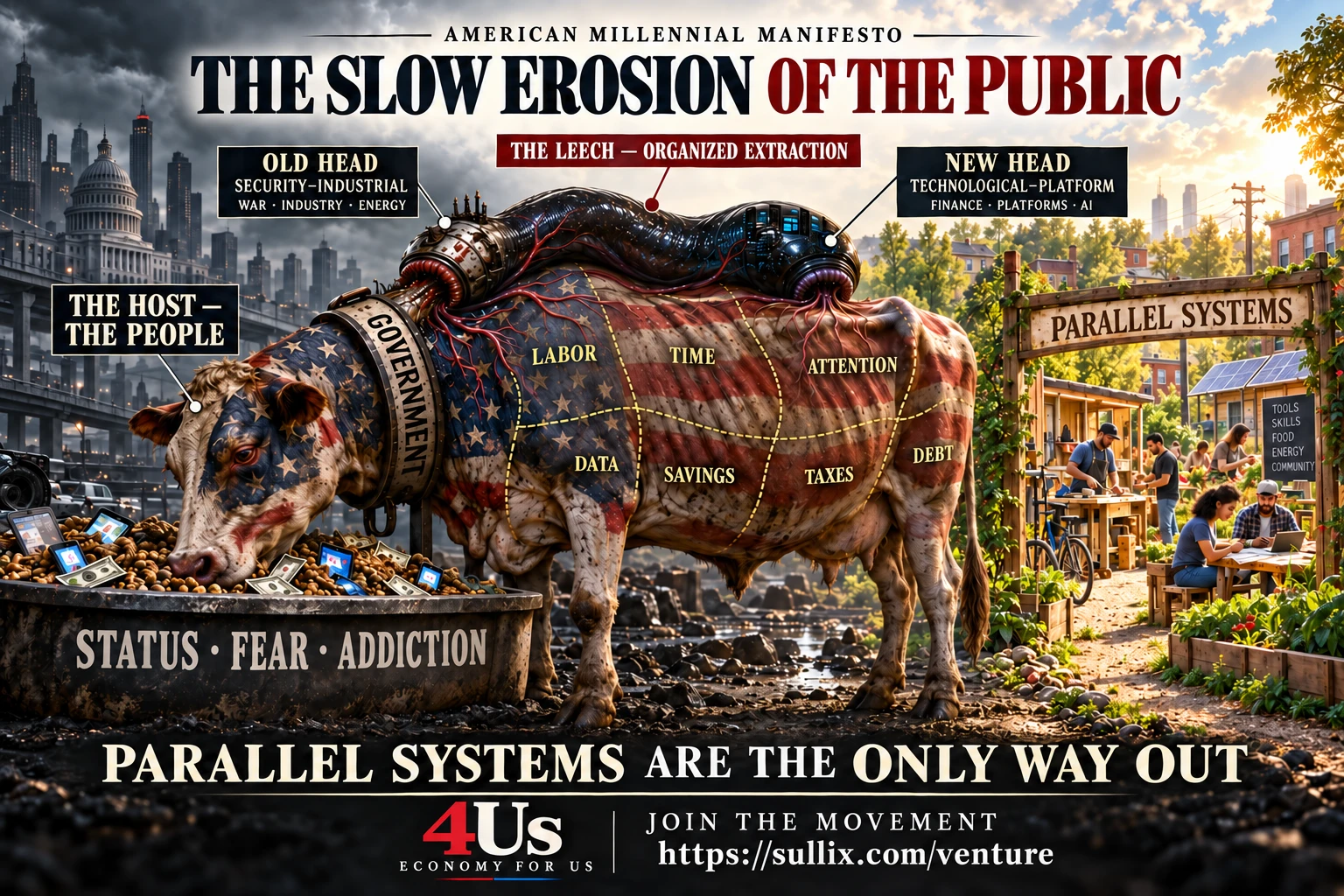
Read the illustration
The Host is the people, pictured as a cow divided into labor, time, attention, data, savings, taxes, and debt. A government collar attaches the Leech, labeled organized extraction. Its old security-industrial head is labeled war, industry, and energy; its new technological-platform head is labeled finance, platforms, and AI. The feeding trough is labeled status, fear, and addiction. Beside it, people build parallel systems around tools, skills, food, energy, and community. The image states, “Parallel systems are the only way out,” and points to 4Us, Economy for Us.
4Us · Economy for UsRead the manifesto.
Earlier editions remain available while the work develops.
- Chapter One: The Leech · Revision requested
- Chapter Two: The Leech’s Anatomy · Explorable figures
The slow erosion of the public
A reader-operated visual metaphor: dependence, extraction, parallel systems. No quantities or forecast implied.
AMM asks who controls essential interfaces, what recurring claims leave for the public, and whether accountable alternatives can change the terms.
How a system gets inside us.
Follow the relationship between institutions, inherited beliefs, and the decisions that keep an arrangement in place—or change it.
Conditions
Who sets the terms?
Ownership, contracts, infrastructure, and law shape what people can access and what refusing will cost.
Ownership → Institutions → Dependence. Terms become lived conditions
Identify who controls the arrangement, who depends on it, and where its costs fall.
Institutions establish conditions.
Interpretation
What starts to feel natural?
Culture can teach people to treat an arrangement as necessary or deserved. Inherited expectations shape what they notice and accept.
Culture → Expectation → Acceptance. An arrangement becomes an assumption
Separate the condition from the story that makes it seem inevitable.
A cultural lesson becomes an expectation; the expectation guides a decision; the decision helps teach the next person what to expect.
Conduct
Who has room to refuse?
Authority and dependence create different possibilities for action. Accountability follows what someone knows, controls, and can realistically change.
Authority → Decision → Consequence. Different positions carry different choices
Examine a decision and its consequences, without assigning a fixed moral character to a class or group.
This is why the anatomy must record conduct as well as rank.
Feedback
What gets reproduced—or corrected?
Decisions can defend the existing terms or make correction possible. Their effects become part of the conditions others encounter.
Consequence → Correction → Conditions. What follows changes the next encounter
Look for whether harm can be named, challenged, and repaired—and who can prevent that correction.
Our conduct then helps reproduce or change the arrangements shaping us.
Consequences return as conditions. The next encounter begins there.
The connection to DOT—and how to read this model
Inspired by DOT’s account of experience, interpretation, action, and consequence. AMM carries that process-oriented lens into public life. Explore DOT’s Experience Loop
The diagram organizes AMM’s argument. Particular claims still need evidence about authority, contribution, dependence, and transferred costs. An official source does not settle a claim by its status; a statistic needs its method, context, and limitations.
Human worth is unconditional; authority and conduct remain answerable.
Letters from the present.
- The Anatomy of the Host
A guide to AMM’s model of organized extraction, unequal power, and accountability.
- AI will not kill you. The one saying that it will, will
A letter to an American adult on AI, private power, and the people shaping its use.
- A Letter to an American Adult: White Pillage
White Pillage Led the West to Oligarchy, Golden Handcuffs, and the Suffering on the Horizon.
- Chapter Two: The Leech’s Anatomy
Two strategic heads, four feeding interfaces, and the public that sustains them.
- Chapter One: The Leech
The opening chapter of the manifesto. An earlier published edition, now under revision.
Build the alternative.
4Us is an economic sovereignty movement developing practical alternatives through cooperation. Sullix is its first platform test.
In development · Start small. Test with real people.
Subscribe to AMM.
Receive complete editions by email. Confirm your address with a one-time code; future letters will arrive in your inbox. Every edition is also free to read here.
Email signup requires JavaScript. Follow AMM with RSS without an account.