 The American Millennial Manifesto
Essay · The American Millennial Manifesto by Henok Ghebrechristos · · 5 min read · Claim levels: model
The Anatomy of the Host
A guide to AMM’s model of organized extraction, unequal power, and accountability.
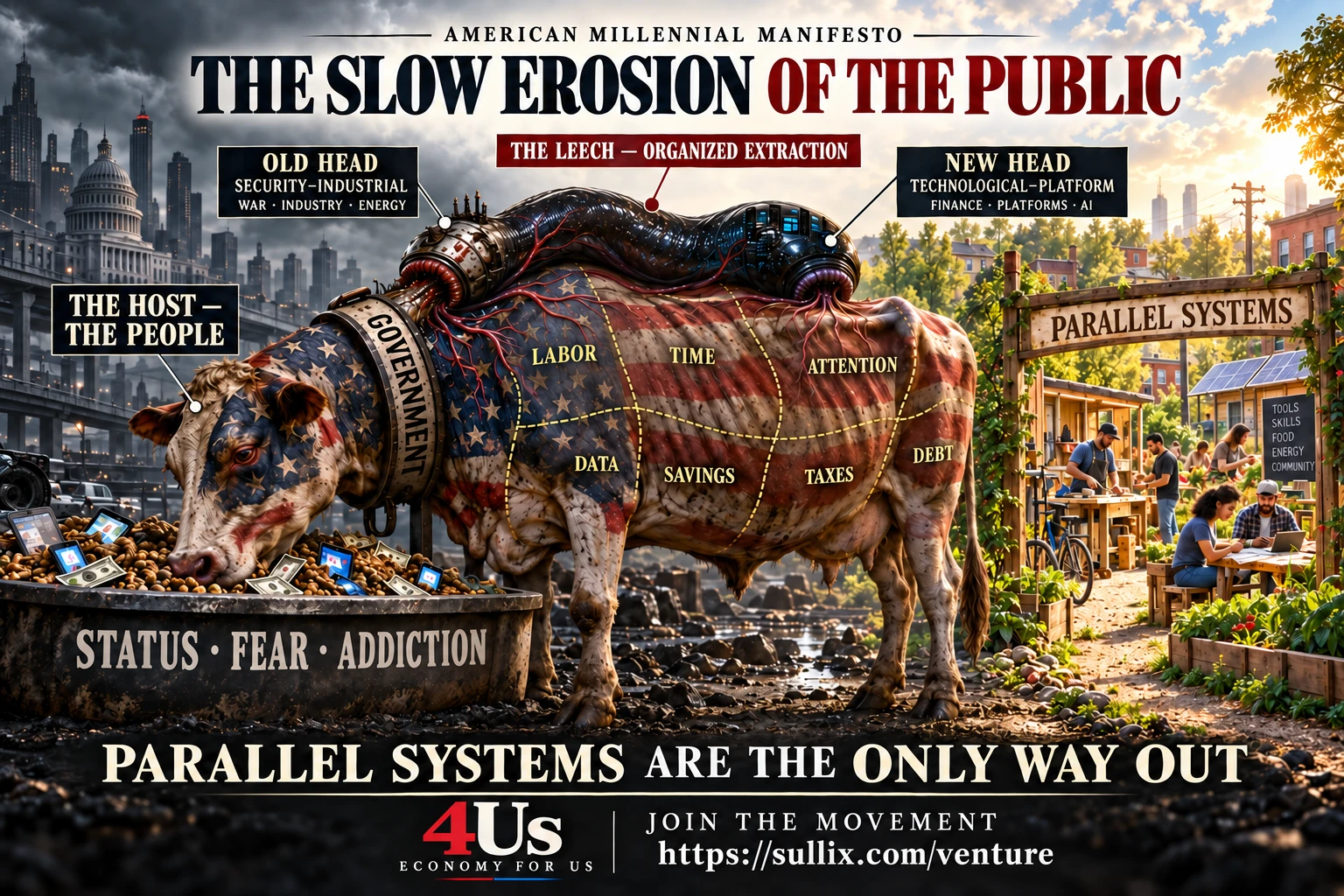
The American Millennial Manifesto · Chapter 3: The Host and the Infection
AMM applies my systemic understanding of society and my process-oriented understanding of individual life. Institutions establish conditions. We interpret those conditions, adapt, and act. Our conduct then helps reproduce or change the arrangements shaping us. Following that process requires us to distinguish the people, the organization of extraction, and the logic through which extraction becomes acceptable.
The Leech and the logic it carries
The Leech has a composition. In AMM, its two strategic centers are the Security-Industrial Oligarchy and the Technological-Platform Oligarchy. The first brings together defense contractors, intelligence firms, energy interests, specialized financiers, consultants, and political networks organized around American state and geopolitical power. The second brings together dominant platforms, computing and artificial intelligence infrastructure, and the financial interests organized around control of digital access, data, and attention. These names identify concentrations of power examined in Chapter 2. They do not make every worker within those industries equally responsible for their decisions.
Its institutional body consists of connected businesses, financial institutions, platforms, contractors, and intermediaries joined through ownership, financing, contracts, infrastructure, and legally protected claims. Wealthy owners and heirs whose position depends on commanding or inheriting those claims belong within this anatomy. The executive who determines the terms and the worker who must accept them occupy different positions, even when both receive income from the same institution.
The four feeding interfaces describe how that body reaches the public: digital access; financial administration and asset ownership; legal control of knowledge; and private claims upon public necessity. Government is a principal attachment point because it makes and enforces laws, awards contracts, supplies funding, and protects claims. Culture is the enabling tissue when it teaches people to accept these terms as natural, necessary, or deserved. The metaphor directs us toward identifiable relationships. Whether a particular institution is extracting requires evidence about its authority, its contribution, the dependence it creates, and the costs it transfers.
The pathogen is the extractive logic of domination. It teaches that fear can be settled through control, that security requires accumulation without end, that another person’s dependence is an opportunity, and that position establishes worth. Infection is the process through which a person learns to apply that logic. A cultural lesson becomes an expectation; the expectation guides a decision; the decision helps teach the next person what to expect. The Leech can carry and reward this logic while drawing its personnel and protection from the society it feeds upon.
Class and the head of the Host
Within the Host, class describes unequal access to resources and unequal room to refuse. Income pays current expenses. Wealth provides reserves, property, and claims that can survive the loss of a job. Institutional authority permits a person to make decisions others must live with. These can accumulate in the same hands, but they can also separate. A well-paid specialist may have little control over a firm. A public official with modest personal wealth may control an important permit, contract, or enforcement decision.
The head of the Host sits where those decisions acquire direction and legitimacy. It includes people who translate institutional objectives into budgets, employment rules, technical systems, legal positions, and public explanations. Their professions do not establish wrongdoing. The guarding function appears when they use their discretion to keep an extractive arrangement beyond effective correction: concealing a known cost, discrediting a substantiated complaint, punishing an objection, or describing an avoidable injury as the necessary price of order.
We must keep this head distinct from the Leech’s ownership and command. A controlling owner or executive who sets the extractive terms belongs within the Leech’s anatomy in that capacity. A manager or professional who implements and protects those terms may function as an intermediary within the Host. One person can occupy both positions. The distinction follows what they control. Moving a powerful executive into the language of public vulnerability must never reduce their accountability for decisions they can change.
Benefit, dependence, and belonging
Protected beneficiaries form a wider circle. A homeowner, investor, pension holder, or well-paid employee may receive advantages without directing the institution producing them. Benefit creates a reason to examine the arrangement and a possible motive to defend it. It does not establish that every beneficiary has defended it. A retirement account with a small holding does not confer the authority of a controlling shareholder. The relevant question is when a person uses the influence they do possess to preserve benefits by closing other people’s opportunities.
People with little room to refuse remain central to the Host. An hourly worker, a heavily indebted professional, a tenant, or a migrant dependent on an employer can understand an injury while facing severe costs for challenging it. Their situations differ, and none is fully described by occupation or income alone. Children, older people, people who are ill or disabled, and unpaid carers belong fully to the public. Receiving care gives a person a claim upon our responsibility, regardless of their ability to supply marketable work.
Authority and responsibility within the model
| Position | Source of power or dependence | What accountability examines |
|---|---|---|
| Leech ownership and command | Control of extractive claims and terms | Decisions, benefits, imposed costs, and repair |
| The Host’s head | Delegated authority and public credibility | How discretion permits harm or enables correction |
| Protected beneficiaries | Assets, income, status, or preferential access | Whether influence is used to protect exclusion |
| People with constrained options | Dependence on wages, housing, care, or permission | Actual freedom to act and support needed to refuse |
These are overlapping relationships, not permanent kinds of people. A nurse can be both a tenant and a supervisor. A manager can protect a worker from retaliation or enforce it. An affluent resident can open a neighborhood to others or organize to keep them out. The same position can be used to obstruct extraction. This is why the anatomy must record conduct as well as rank.
Race, division, and responsibility
Race crosses these relationships and shapes their history. Black, Asian, White, Native, Latino, multiracial, and other communities contain people with different resources and responsibilities. Brown is a meaningful identity for many people, but it is not one consistent statistical category. Migration history and citizenship are additional dimensions that cut across race. The divisions drawn on the Host show differences through which people can be separated; they must not turn whole communities into organs assigned a single moral character.
The guard is identifiable through a sequence: a person has authority, receives evidence of harm, has a feasible opportunity to respond, and uses that authority to prevent correction. Intentional deception and retaliation deserve especially direct accountability. Failure to act requires examining what was known and what action was possible. A comfortable position increases the questions a person must answer; a difficult position does not make every harmful act unavoidable. The standard remains specific enough to investigate and demanding enough to reach people who have learned to call their own discretion powerlessness.
End of essay