 The American Millennial Manifesto
Essay · The American Millennial Manifesto by Henok Ghebrechristos · · 26 min read · Claim levels: model, hypothesis
Chapter Two: The Leech’s Anatomy
Two strategic heads, four feeding interfaces, and the public that sustains them.
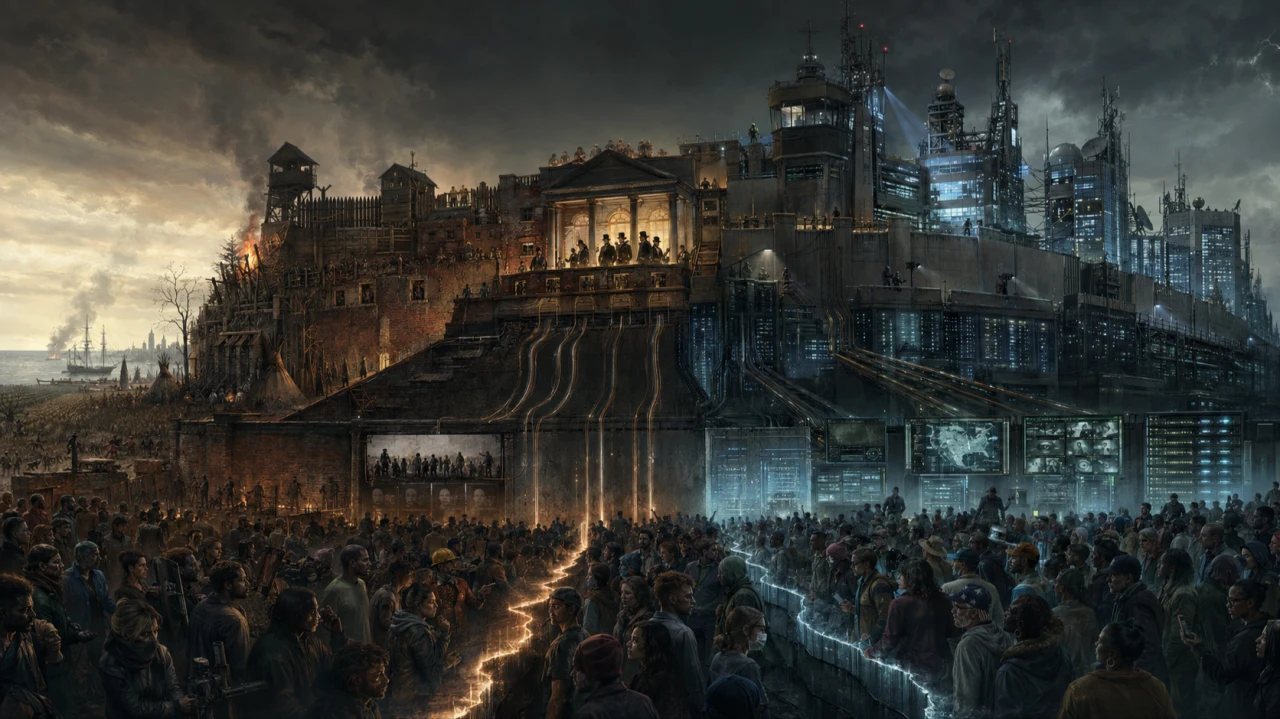
Earlier published edition. Originally published on LinkedIn on 2026-07-29. Original publication.
Introduction
Follow the Money and You Will Find Your Misery
Something has attached itself to your life. You may not know the pathogen, but you recognize the symptoms: your loss of confidence in the country, the exhaustion that rest does not cure, the insecurity that follows you even when you are working, the sense that every necessity now has a gatekeeper standing between you and relief.
You are encouraged to interpret these pressures one at a time. The rent increase is a private housing problem. The medical bill is a private health problem. The student loan is a private educational decision. The disappearing job is a private failure to adapt. The compulsive screen is a private failure of discipline. Each wound is returned to you as a separate personal deficiency while the environment producing the wounds remains unnamed.
Distress is individualized while the architecture producing it is preserved. As I have discussed in Chapter one, this is characterized as inversion. Inversion of reality.
I call that architecture the Leech. The Leech is not the private sector, and it is not every wealthy person, corporation, public official, or intermediary. Productive enterprise builds, invents, coordinates, repairs, and takes legitimate risk.
The Leech appears where concentrated private power and captured public authority converge around something people cannot reasonably avoid, then convert that dependence into a recurring claim upon their labor, savings, attention, data, health, or future.
A biological leech does not need to overpower the whole body. It needs a point of attachment. It numbs the site, keeps the blood flowing, and feeds while the host continues moving. The political economy described in this chapter behaves similarly. Its anesthesia is not one centrally designed spectacle. It is the accumulated noise of outrage, entertainment, status competition, partisan theater, and private shame. Its anticoagulant is dependency: debt that must be serviced, rent that must be paid, insurance that cannot be abandoned, platforms that cannot easily be left, and institutions said to be too important to challenge.
No secret council is required. The incentives are sufficient. Each institution can pursue its own advantage, each executive can defend the decision as strategic, and each public official can call the arrangement necessary. The result can still be coordinated extraction without coordinated intention.
Follow the money and the separate injuries begin to converge. You find the same structure repeatedly: an essential interface, a dependent public, a private extraction, and a government that protects the extraction more reliably than it protects the person passing through the interface. The names of the firms change. The mechanism persists.
This chapter labels that mechanism the Leech’s Anatomy and cuts it open. It identifies two strategic heads, four feeding interfaces, the principal point of attachment, and the host supplying nearly everything. The purpose is to give your pain a practical map.
The Leech’s Anatomy
The Leech has two strategic heads, an institutional body organized around four feeding tubes, one principal point of attachment, and one host. The old head grew through war, energy, heavy industry, national borders, public procurement, and the geopolitical machinery of the American state.
The newer head grew through financialization, computation, digital platforms, artificial intelligence, and the conversion of attention into and asset. The previous head depends upon the state’s organized force. This one increasingly governs the interfaces through which ordinary life is perceived, coordinated, and exchanged.
This head is particularly effective at eroding you by placing you inside a continuous moral conundrum. To participate in modern life, you must increasingly depend upon systems whose conduct you may oppose. To communicate, you submit to surveillance. To obtain convenience, you enter supply chains built upon distant exploitation. To secure retirement, you place your savings inside institutions that may profit from housing scarcity, war, ecological destruction, or the privatization of public necessity. To remain employed, visible, connected, and socially functional, you are repeatedly asked to cooperate with what you would not consciously choose.
The compromise becomes ordinary. Then it becomes invisible.
This is how the newer head weakens moral agency. It does not always command you to abandon your principles. It constructs the conditions under which living by them becomes costly, isolating, or nearly impossible. It forces participation, renames that participation choice, and gradually teaches the person to stop examining what participation requires.
But neither head could feed at this scale without a culture prepared to accommodate it.
Culture is not a fifth feeding tube. It is the tissue surrounding the entire organism. It teaches the host what to admire, what to tolerate, what to pursue, and what to consider inevitable. It presents accumulation as merit, domination as strength, convenience as progress, and dependence as freedom. It trains people to measure success by proximity to the machinery extracting from them. Eventually, extraction no longer appears as an invasion of public life. It appears like public life itself.
The Leech survives because the culture has made its appetite seem natural.
The four mouths are not separate species. They are the interfaces through which the body feeds*: digital access*, financial administration and asset ownership, legal control of knowledge, and private claims upon public necessity. Government is the principal attachment point because it writes and enforces the rules that make those claims durable. The host is the public, supplying labor, taxes, savings, purchases, debt, land, water, electricity, attention, data, and legitimacy.
Between you and shelter stands a landlord, lender, or fund. Between you and medical care stands an insurer, patent, or pharmaceutical pricing system. Between you and the market stands a tech platform. Between you and other people stands an algorithm. Between your retirement savings and the corporations stands an asset manager. Between public need and public action stand contractors, lobbyists, privatized utilities, and institutions too embedded to challenge without disruption.
This does not make every intermediary parasitic. Productive enterprise creates goods, coordinates difficult work, takes risks, maintains infrastructure, and is entitled to compensation. The Leech’s power begins where ownership of an essential interface becomes the authority to collect indefinitely from people who cannot reasonably avoid it. The difference is not profit versus purity. It is production under competition versus extraction from dependence.
ANATOMICAL PRINCIPLE: The Leech attaches to an interface, converts dependence into recurring revenue, and uses concentrated power to make the interface harder to leave.
The Two Heads
The Old Head: The Security-Industrial Oligarchy
The old head we call the Security-Industrial Oligarchy, or SIO. Its core includes defense contractors, intelligence firms, energy interests, consultants, specialized financiers, and political networks organized around American state power. This head is territorial. It requires the American tax base, military procurement, industrial facilities, research institutions, transportation networks, energy systems, and a government able to project force abroad.
The state is simultaneously its customer, financier, regulator, and protector. Lockheed Martin ended 2025 with nearly $194 billion in backlog and reported that 72 percent of its sales came from the U.S. government.[3] Boeing reported that 35 percent of its 2025 revenue was earned under U.S. government contracts.[4] These figures do not prove that national security is fictitious. They reveal a structural fact: a narrow group of private firms has become indispensable to the state, while continuing public expenditure is indispensable to those firms.
The danger lies in the incentive created by that mutual dependence. Every genuine threat can enlarge an order book. Every emergency can narrow oversight. Every new enemy can justify accelerated procurement, expanded surveillance, replacement weapons, and decades of maintenance. The Government Accountability Office continues to report rising costs and schedule problems across major weapons programs.[5] The threat may be real; the commercial incentive remains.
You experience the transfer indirectly. It appears when extraordinary resources can be mobilized for security while schools, transit, housing, public health, and ordinary infrastructure are described as unaffordable. The extraction occurs through public accounts. The consequence enters private life.
The New Head: The Technological-Platform Oligarchy
The newer head is the Technological-Platform Oligarchy, or TPO. It controls increasingly essential layers of modern life we can call essential interfaces: cloud computing, search, social media, advertising, online marketplaces, artificial intelligence, semiconductor supply, data centers, and the systems through which society communicates and coordinates. Its infrastructure is built on land and energy, but its reach is global. Its potential market is the connected human population.
The old head requires a functioning state. The new head requires a connected user. That user does not have to be secure, informed, prosperous, or psychologically healthy. An anxious person still scrolls. An isolated person still generates data. An exhausted household still pays subscriptions. A frightened public remains commercially valuable. The new head does not require the host to flourish. It requires the host to remain connected, measurable, dependent, and available for transaction.
The two heads are now joining and that is the source of your headache and depression.
In July 2025, the Department of Defense announced awards to Anthropic, Google, OpenAI, and xAI, each with a ceiling of $200 million, for frontier-AI work across national-security mission areas.[6] The Defense Innovation Unit’s Thunderforge program is integrating commercial AI, simulation, and agent-assisted planning into operational and theater-level military decision-making.[7] The old head is acquiring a digital nervous system. The new head is acquiring the resources, protection, and authority of the state.
Their convergence requires no secret council. It happens openly through contracts, infrastructure, lobbying, personnel, investment, procurement, and mutual dependence. One head expands what the country can do. The other increasingly shapes what the population can see. Together they form an architecture of control over both your action and perception.
The Four Mouths
1. The Digital Toll Collectors
Apple, Amazon, Alphabet, and Meta create real products and useful services with public labor. That achievement is not an accusation. My concern begins where innovation becomes private control over a route that others must use to participate. The developer writes the application, the merchant owns the inventory, the journalist reports the story, the artist creates the work, and the public supplies the attention. The platform controls admission, ranking, payment, visibility, and access. This is an architecture of control.
Apple’s Services segment generated $109.2 billion in fiscal 2025 at a gross margin of 75.4 percent.[8] The category includes more than the App Store, so it should not be misrepresented as pure app tolls. The relevant fact is architectural: Apple governs a principal path to hundreds of millions of devices and can write the technical and commercial rules governing that path.
Amazon reported $172.2 billion in third-party seller services and $68.6 billion in advertising services in 2025.[9] A merchant may pay the same platform to enter the market, warehouse the product, deliver it, advertise it, and place it where a buyer can see it. The seller assumes inventory risk. The platform governs access and visibility.
Alphabet generated $294.7 billion from advertising in 2025.[10] Meta generated approximately $196.2 billion from advertising while its family of applications reached an average of 3.58 billion people each day in December 2025.[11] The content comes from users, publishers, artists, organizations, and communities. The behavioral signals come from you. The platform observes, ranks, predicts, recommends, and monetizes both.
Values reproduced from the author’s published chapter; not independently verified. A cited institution’s status does not establish accuracy.
| Category | Value | Cited source |
|---|---|---|
| Alphabet advertising | 294.7 | Alphabet, 2025 Form 10-K |
| Amazon seller + advertising | 240.8 | Amazon, 2025 Form 10-K |
| Meta advertising | 196.2 | Meta, 2025 Form 10-K |
| Apple Services | 109.2 | Apple, 2025 Form 10-K |
These are different company-reported revenue categories, not profit or a measure of extraction. Amazon combines seller services (172.2) and advertising (68.6); Apple Services includes more than the App Store. Do not add these to wealth or assets under management.
Figure 1. Selected 2025 revenue collected through digital interfaces. These categories reveal scale, not identical business models.[8]–[11]
You encounter this architecture as convenience. The small business encounters it as dependence. The citizen encounters it as a privately ordered information environment. Once an interface becomes socially necessary, its fee ceases to look like an ordinary price. It begins to resemble a privately imposed tax on participation.
The new head’s greatest advantage is that it can participate in your perception of the feeding. This is malicious to your soul. A platform can study what frightens you, what angers you, what interrupts judgment, and what returns you to the screen. The consequences arise as distraction, agitation, compulsive comparison, or the persistent sense that reality is collapsing faster than it can be understood. The suffering feels intimate. The revenue remains institutional. This is the Leech defining characteristics.
2. The Asset Hoarders and Financial Gatekeepers
The Leech requires a circulatory system capable of moving capital among corporations, assets, governments, and jurisdictions. BlackRock, Vanguard, and State Street occupy important positions within that system. They do not personally own the trillions reported as assets under management. Those assets belong to pension funds, retirement accounts, governments, institutions, and individuals. Any analysis that treats Assets Under Management (AUM) as the manager’s own wealth is false.
The power is subtler. At the end of 2025, BlackRock reported $14 trillion in assets under management, Vanguard approximately $12 trillion, and State Street $5.67 trillion.[12]– [14] These firms structure funds, route flows, administer voting and stewardship programs, lend securities, and engage corporate boards at a scale unavailable to the dispersed people whose capital they manage.
Values reproduced from the author’s published chapter; not independently verified. A cited institution’s status does not establish accuracy.
| Category | Value | Cited source |
|---|---|---|
| BlackRock | 14 | BlackRock, full-year 2025 results |
| Vanguard | 12 | Vanguard in a Nutshell, December 2025 |
| State Street | 5.67 | State Street, 2025 Form 10-K |
Assets under management are client capital administered by a firm, not the firm’s own wealth. Values are rounded. This comparison does not quantify common ownership, voting control, or extraction.
Figure 2. Assets under management at year-end 2025. AUM measures client capital administered, not wealth owned by the firms.[12]–[14]
Your retirement account may hold the shares, but you rarely exercise meaningful authority over the corporate power attached to them. This is the central inversion: millions of workers collectively supply capital while its practical administration concentrates inside a small number of institutions. The host supplies the blood. The financial interface helps determine where it flows. This is its feeding tube.
Housing exposes a more direct form of financialization. In 2024, Blackstone completed a $3.5 billion acquisition of Tricon Residential, a company with a large single-family rental platform.[15] The Federal Trade Commission estimated in 2025 that mega-investors collectively owned and operated roughly 446,000 single-family homes nationwide.[16] A 2026 GAO analysis found that institutional ownership increased from 2018 through 2024 across six selected metropolitan areas; in 2024, qualifying investors held 22 percent of single-family rentals in Jacksonville, 13 percent in Phoenix, and 9 percent in Dallas, while remaining a much smaller share of all single-family homes.[17]
This requires precision. Institutional investors do not own most American homes, and the evidence on their national effect on homeownership is not conclusive. Their power is geographically concentrated. That local concentration is exactly the point. A national percentage can look modest while a neighborhood, price band, or metropolitan rental market becomes subject to portfolio-scale acquisition and management.
A home remains shelter to the person inside it. To a financial model it becomes a yield stream composed of rent, fees, appreciation, maintenance cost, vacancy, and eviction probability. The neighborhood becomes a portfolio. The tenant receives recurring payment. The abstraction belongs to the owner. The insecurity belongs to the host. This is the Leech – extractive by instinct and architecture.
3. The Innovation Hoarders
The third mouth feeds through legal ownership of knowledge. Patents can reward inventions, attract investment, and protect legitimate risk. They can also become walls around publicly supported science, extending market control after the public has already absorbed part of the research risk. The problem is not the existence of intellectual property. It is the use of legal exclusivity to convert captive human need into pricing power.
Moderna’s COVID-19 vaccine demonstrates the mixed architecture. The federal government committed up to $955 million through BARDA for development through licensure and up to $1.525 billion for the manufacturing and delivery of the first 100 million doses. Moderna’s own disclosure stated that BARDA reimbursed 100 percent of allowable development-program costs under the contract.[18] Private capability and public science produced an extraordinary result together. The allocation of risk, ownership, price, and long-term control therefore deserves the same public scrutiny as the achievement.
Humira shows how valuable exclusivity can become. AbbVie reported that the drug accounted for approximately 37 percent of its total net revenue in 2022, immediately before U.S. biosimilar competition began.[19] The medicine answered real human need. The surrounding exclusivity also sustained an enormous revenue stream. In healthcare, the user is not negotiating over an optional luxury. Illness creates captivity.
Human vulnerability becomes pricing power. This is the first bite felt when the Leech attaches itself to you.
When the University Forgets the Public
The decline of educational institutions belongs to this anatomy, but it must be understood precisely. American universities have not stopped producing discoveries. Many remain among the most productive research institutions in the world. What they have gradually surrendered is their clarity of public purpose.
Follow knowledge upstream. Before the pharmaceutical company acquires a patent wall, there is often a university laboratory, a federal grant, and generations of accumulated scientific work. In 2024, the federal government supplied more than half of all research and development funding performed by American universities.[20] The public therefore remains one of the country’s greatest investors in knowledge. Yet the public does not necessarily retain meaningful control over how that knowledge is used, priced, or distributed.
The same architecture appears inside education itself. States withdraw support. Universities raise tuition, compete for grants and wealthy donors, construct licensing offices, pursue corporate partnerships, and reorganize themselves around rankings, revenue, and prestige. The student ceases to be understood primarily as a developing citizen. The student becomes a customer purchasing future earning power, frequently with borrowed money. The researcher becomes a grant engine. Knowledge becomes intellectual property. Education becomes a credential.
None of these functions are inherently corrupt. Universities need money. Research must sometimes be commercialized before it can reach the public. Patents can provide legitimate incentives for the costly work between discovery and usable medicine. Corruption begins when the institution forgets who made the discovery possible and whom knowledge was meant to serve.
You experience the forgetting personally. You enter the university seeking understanding and leave carrying debt. Your professor may be teaching under precarious conditions while the institution advertises its research portfolio, athletic brand, executive leadership, and commercial partnerships. Your education is described as an investment in yourself because society has withdrawn from the responsibility of investing in you.
The institution continues producing knowledge. What it is losing is its capacity to form citizens.
That is the connection to the Leech. The Innovation Hoarder does not merely place a patent around the final discovery. Its logic travels backward into the institutions that decide what knowledge deserves to be pursued, which departments deserve to survive, whose labor remains disposable, and what education itself is for. The public finances discovery, the institution administers it, private ownership encloses it, and the citizen pays to enter at both ends.
A republic cannot survive indefinitely when its schools train workers for the economy but no longer form people capable of judging the economy. Education is supposed to expand the citizen’s capacity to understand a complex world and participate in governing it. Once education is reduced to private career preparation, the university may remain technically advanced while becoming civically hollow.
4. The Drainers
The fourth mouth feeds through public necessity. Defense procurement is the most visible form, but the pattern also appears when roads, water systems, electricity, broadband, prisons, healthcare administration, or other essential functions are converted into private concessions without meaningful competition or public exit. The private operator may contribute capital and expertise. Extraction begins when the public remains captive while price, service quality, and reinvestment become subordinate to financial extraction.
This is why the point of attachment is government. The state collects taxes, writes contracts, enforces patents, protects ownership, finances research, constructs infrastructure, rescues institutions, and decides which private interests may convert public necessity into private revenue. Government is not identical to the Leech. Its captured portions serve the parasite; its so-called democratic and public-serving capacities remain part of the host’s weakened immune system.
The attachment is maintained through lobbying, campaign finance, revolving personnel, privatization, tax preferences, subsidies, procurement dependence, and the quiet rewriting of public priorities around private necessity. The contractor becomes too specialized to replace. The platform becomes too embedded to leave. The financial institution becomes too large to fail. The patent becomes too expensive to contest. The public is told there is no alternative. That sentence marks the feeding point.
Where the Capital Lives
In the first quarter of 2026, American households held roughly $174 trillion in net worth. The problem is distribution and control. The Federal Reserve estimated that the bottom half held only 2.5 percent of aggregate wealth, the next 40 percent held 29.6 percent, the 90th through 99th percentiles held 36.3 percent, and the top 1 percent held 31.6 percent.[1]
Values reproduced from the author’s published chapter; not independently verified. A cited institution’s status does not establish accuracy.
| Category | Value | Cited source |
|---|---|---|
| Top 1% | 31.6 | Federal Reserve, Distributional Financial Accounts |
| Next 9% | 36.3 | Federal Reserve, Distributional Financial Accounts |
| Middle 40% | 29.6 | Federal Reserve, Distributional Financial Accounts |
| Bottom 50% | 2.5 | Federal Reserve, Distributional Financial Accounts |
Government-source estimates as cited in the chapter, pending independent verification. These rounded, mutually exclusive percentile groups sum to 100. Wealth shares do not measure the number of households or explain the causes of inequality.
Figure 3. Distribution of U.S. household net worth, Q1 2026. Values are rounded; the groups sum to 100 percent.[1]
The imbalance becomes sharper when the asset is corporate equity. In the same quarter, the top 1 percent held 50.2 percent of corporate equities and mutual-fund shares, while the bottom 50 percent held 1.1 percent.[2] This is how rising market values can produce great national wealth without producing comparable economic sovereignty for most households.
Values reproduced from the author’s published chapter; not independently verified. A cited institution’s status does not establish accuracy.
| Category | Value | Cited source |
|---|---|---|
| Top 1% | 50.2 | FRED, WFRBST01122 |
| Bottom 50% | 1.1 | FRED, WFRBSB50203 |
Government-source estimates as cited in the chapter, pending independent verification. Only two groups are shown; they do not sum to 100. This measures corporate equities and mutual-fund shares, not all household wealth.
Figure 4. Share of U.S. corporate equities and mutual-fund shares held by the top 1 percent and bottom 50 percent, Q1 2026.[2]
The middle 40 percent is not empty-handed. It held about $51.5 trillion in net worth in early 2026.[1] But much of middle-class security is tied to homes and retirement assets that are difficult to access without selling, borrowing, paying penalties, or waiting for old age. Ownership exists, yet immediate agency remains constrained. Meanwhile, the institutions administering credit, housing, platforms, and retirement flows collect fees continuously.
DO NOT COMBINE UNLIKE QUANTITIES: Household net worth, corporate market capitalization, company revenue, and assets under management measure different things. They may be compared only with explicit caveats; they must never be added together and called 'capital controlled.
The Bigger Danger - The Leech is Abandoning America
And it’s taking all the capital with it. The original temptation is to describe this as capital flight: the wealthy abandon the physical ship and upload their wealth into a digital and financial cloud. The image captures something real, but the literal claim is too simple. Much of the capital remains invested in American companies, homes, infrastructure, debt, and government securities. BlackRock and Vanguard do not remove every managed dollar from the nation. Technology companies remain intensely dependent on American law, energy, research, labor, land, and military protection.
The deeper flight is from reciprocal obligation.
Capital is becoming easier to move, diversify, securitize, and govern from a distance, while the human consequences remain local. A house cannot leave Denver, but the claim upon its rent can sit inside a national portfolio. A worker cannot move as frictionlessly as an investment allocation. A data center consumes water and electricity in a particular community, while the value it creates may accrue through a global balance sheet. A retirement fund may hold American productive wealth, yet the worker supplying that capital possesses little authority over its use.
This is not the disappearance of capital from America. It is the detachment of capital from responsibility to the American public that made its scale possible.
The transition is already visible.
In 2024, BlackRock, Microsoft, Global Infrastructure Partners, and Abu Dhabi’s MGX created an AI-infrastructure partnership intended to mobilize $30 billion in equity and as much as $100 billion after debt financing. Its investments were planned primarily for the United States, with the remainder directed toward American partner countries. The partnership later moved to acquire Aligned Data Centers at an enterprise value of approximately $40 billion, gaining a network of fifty campuses and more than five gigawatts of operational and planned capacity across the United States and Latin America. Its financial anchors now include the sovereign wealth funds of Kuwait and Singapore. BlackRock, Aligned Data Centers.
The same architecture is extending into major BRICS economies. In the UAE, OpenAI, G42, Oracle, Nvidia, Cisco, and SoftBank are developing a one-gigawatt Stargate cluster, with the first 200 megawatts expected in 2026. The agreement was coordinated with the American government and combines UAE investment in American infrastructure with American-led infrastructure inside the UAE. OpenAI describes the site as capable of serving markets within a two-thousand-mile radius containing as much as half the world’s population. OpenAI
In India, Microsoft announced an additional $17.5 billion investment for cloud and AI infrastructure, operations, and training between 2026 and 2029, following an earlier $3 billion commitment. The investment includes new hyperscale capacity and the integration of Microsoft’s AI systems into public platforms serving hundreds of millions of workers. This is not simply the sale of software. It is participation in the construction of another country’s computational and administrative infrastructure. Microsoft
Do not misread these developments. Western capital is not surrendering America to BRICS, nor is it negotiating with BRICS as one unified political body.
It is positioning itself between worlds.
The Leech uses American research, law, public financing, energy, military protection, and technological leadership as its base while accepting foreign sovereign capital and extending privately controlled infrastructure into the populations and markets where future demand will be concentrated.
American government is helping construct this bridge. Its AI-export policy calls for industry consortia to sell foreign governments complete American technology packages: chips, servers, data centers, cloud platforms, models, applications, cybersecurity systems, and technical standards. It also authorizes federal financing, loan guarantees, diplomatic assistance, and other forms of state support. Public power is being used to extend privately governed technological infrastructure across the world. White House executive order
What the announcements rarely disclose are the terms that matter most: ownership rights, expected returns, electricity guarantees, chip allocations, water commitments, public subsidies, security concessions, data-governance arrangements, and the liabilities communities will carry. We can see the capital moving. We can see the partnerships forming. We can see the infrastructure changing hands. What remains largely beyond public scrutiny is who will ultimately govern and to whom that governing power will be accountable.
This is the transition the American Millennial Manifesto is warning you about.
Read the spectacle of the present administration through this lens. War, alleged drug boats, foreign enemies, border emergencies, and permanent national danger are not real danger. They however concentrate attention, enlarge executive authority, and keep the older head of the Leech at the center of public consciousness while the newer head acquires the infrastructure of the future.
I cannot prove that every crisis was manufactured to conceal this transition. That claim is unnecessary. A crisis becomes a smokescreen whenever it consumes the citizen’s entire field of vision while more durable transfers of ownership and authority proceed without comparable scrutiny.
Do not watch only the explosion. Watch the contract signed while you were watching it.
Meanwhile bottom half is drained because nearly all income must circulate immediately through housing, healthcare, debt service, food, transportation, utilities, and digital tolls.
The middle class appears secure in aggregate but carries wealth inside assets it cannot easily command. The top of the distribution owns the largest share of liquid and appreciating financial claims, allowing it to benefit when platform and asset values rise even as the physical quality of community life declines.
The flight, then, is not merely geographic. It is architectural.
Wealth moves upward into claims that are liquid, diversified, and globally mobile. Obligation moves downward into lives that remain embodied, indebted, taxable, and geographically fixed.
The Leech keeps the upside frictionless and returns the friction to the host.
The Host
When the host dies, will you die with it?
The American Millennial Manifesto diagnoses your condition as belonging to a society on its deathbed. A society infected with a degenerate extractive order – the Leech.
This does not mean the United States will disappear tomorrow. A civilization approaches death when the harms accumulated by its power exceed its willingness to account for them. Work without security, wealth without public well-being, knowledge without wisdom, and technology without freedom are not the original diseases. They are symptoms of power released from accountability.
The rest of the world knows this. America did not recently acquire this sickness. The Leech came with the country. It grew beside the republic, feeding through the contradictions the nation repeatedly refused to resolve. You have not been suddenly defeated. You have been morally stunted by centuries of lack of accountability and miseducation.
The host is not dying because it lacks resources. It is dying because those resources are increasingly organized against its own healing. Communities lose the time, trust, and shared reality required to remain communities.
This is death by erosion.
SIO commands procurement, logistics, surveillance, and organized force. TPO commands computation, communication, commerce, data, and attention. Financial institutions circulate accumulated savings while converting human necessities into yield-bearing assets. Intellectual-property rentiers construct legal walls around knowledge. Captured portions of government secure the attachment.
You supply everything else.
Your labor keeps the system productive. Your taxes finance its contracts. Your savings provide its capital. Your purchases sustain its platforms. Your debt becomes its asset. Your land, water, and electricity support its infrastructure. Your attention trains its machinery. Your data improves its ability to understand, predict, and influence you.
Return now to your own life. The rent consuming your income, the debt following you into adulthood, the medical care you postpone, the unstable work, the deteriorating public services, the attention you can no longer command, and the exhaustion you interpret as personal failure—these are not merely private misfortunes. They are symptoms of a recurring architecture that converts your vulnerability into durable private power.
The Leech extracts structurally and returns the consequence personally.
The Pathogen Infecting the Host
Beneath this architecture is the pathogen it carries: an extractive logic of domination. It teaches that fear can be resolved through control, that security requires endless accumulation, that strength means power over others, and that another person’s dependence is an opportunity for profit. This is not mere materialism. It is a product of the old pathogen of supremacy—the delusion America chose to bury rather than confront, repair, and relinquish.
The pathogen enters institutions as enclosure, surveillance, artificial scarcity, and private rule. It enters culture as the worship of wealth, convenience mistaken for freedom, and domination disguised as strength. It enters the citizen as status hunger, tribal hatred, moral numbness, and the willingness to tolerate suffering when that suffering makes one’s own life easier.
This is why the symptoms appear both around you and within you.
You are not responsible for having been born into an infected host. But once the infection becomes visible, you become responsible for whether it continues through you.
This does not mean every hardship has one cause, every intermediary is parasitic, or every person inside these institutions is an extractor. Human suffering is older than capitalism, and large institutions contain builders as well as predators.
The claim is narrower: the same logic repeatedly converts dependence into concentrated power and then teaches the injured person to interpret the result as personal failure.
The Leech is the carrier. Extractive domination is the pathogen. The condition of your life is where the infection becomes visible.
The danger is intensified by timing. The Leech is extending itself into the global economy while retaining America as a command center, military protector, source of public subsidy, pool of savings, consumer market, and generator of technology. It does not need the entire host to remain healthy. It needs only the organs that protect and reproduce its power.
America can therefore remain formidable abroad while becoming progressively unlivable at home: capable of securing global capital but increasingly incapable of securing ordinary life.
That is how the host is dying— through organized depletion.
Yet dying is not death. I believe the American public has the capacity to turn it around. But recovery requires detachment from the Leech, and detachment will be the most arduous stage.
The Leech has spent generations organizing our dependence. We must now organize our independence.
Conclusion
Be aware. Pain of this scale does not sit quietly; it demands a face to blame. The Leech knows this — it has known it since 1676 — and so it does what it has always done: it hands the hurting a target. The migrant. The neighbor of another color. The other party's voter. The Muslim. The newly arrived, the differently worshipping, the visibly struggling. This is the Offsprings' (chapter 1) daily assignment: the Smile dramatizes the decoy, the Mask individualizes it, the Suit legislates against it, the Shield polices it — and the Two Heads, unmentioned, continue to feed.
Resist the destructions, find an anchor. This is Millennial Manifesto’s recommended dose of your illness for the short term.
References
[1] Board of Governors of the Federal Reserve System, Distributional Financial Accounts; Q1 2026 wealth levels and shares by percentile group. https://www.federalreserve.gov/releases/z1/dataviz/dfa/distribute/table/
[2] Federal Reserve Bank of St. Louis, FRED, Share of Corporate Equities and Mutual Fund Shares Held by the Top 1% and Bottom 50%, Q1 2026 (series WFRBST01122 and WFRBSB50203). https://fred.stlouisfed.org/series/WFRBST01122
[3] Lockheed Martin, 2025 Annual Report. https://www.sec.gov/Archives/edgar/data/936468/000162828026021234/a2025lmars.pdf
[4] The Boeing Company, 2025 Form 10-K. https://www.sec.gov/Archives/edgar/data/12927/000162828026004357/ba-20251231.htm
[5] U.S. Government Accountability Office, Weapon Systems Annual Assessment, GAO-26-108457, July 2026. https://www.gao.gov/assets/gao-26-108457.pdf
[6] Department of Defense Chief Digital and Artificial Intelligence Office, “CDAO Announces Partnerships with Frontier AI Companies,” July 14, 2025. https://www.ai.mil/Latest/News-Press/PR-View/Article/4242822/cdao-announces-partnerships-with-frontier-ai-companies-to-address-national-secu/
[7] Defense Innovation Unit, “Thunderforge Project to Integrate Commercial AI-Powered Decision-Making,” March 5, 2025. https://www.diu.mil/latest/dius-thunderforge-project-to-integrate-commercial-ai-powered-decision-making
[8] Apple Inc., 2025 Form 10-K. https://www.sec.gov/Archives/edgar/data/320193/000032019325000079/aapl-20250927.htm
[9] Amazon.com, Inc., 2025 Form 10-K. https://www.sec.gov/Archives/edgar/data/1018724/000101872426000004/amzn-20251231.htm
[10] Alphabet Inc., 2025 Form 10-K. https://www.sec.gov/Archives/edgar/data/1652044/000165204426000018/goog-20251231.htm
[11] Meta Platforms, Inc., 2025 Form 10-K and full-year results. https://www.sec.gov/Archives/edgar/data/1326801/000162828026003942/meta-20251231.htm
[12] BlackRock, Inc., Full-Year 2025 Results and Form 10-K. https://www.sec.gov/Archives/edgar/data/2012383/000119312526013503/blk-ex99_1.htm
[13] Vanguard, “Vanguard in a Nutshell,” data as of December 31, 2025. https://www.ch.vanguard/content/dam/intl/europe/documents/en/vanguard-in-a-nutshell-eu-en.pdf
[14] State Street Corporation, 2025 Form 10-K. https://s203.q4cdn.com/888565246/files/doc_financials/2025/q4/STT-2025-12-31-10-K-final-with-exhibits.pdf
[15] Blackstone, “Blackstone Real Estate Completes Privatization of Tricon,” May 1, 2024. https://www.blackstone.com/news/press/blackstone-real-estate-completes-privatization-of-tricon/
[16] Federal Trade Commission, “FTC Seeks Public Comment on Single-Family Rental Home Mega Investors Study,” January 15, 2025. https://www.ftc.gov/news-events/news/press-releases/2025/01/ftc-seeks-public-comment-single-family-rental-home-mega-investors-study
[17] U.S. Government Accountability Office, Rental Housing: Institutional Investor Ownership, GAO-26-108675, March 24, 2026. https://www.gao.gov/assets/gao-26-108675.pdf
[18] Moderna, Inc., U.S. Government Supply Agreement disclosure, August 11, 2020. https://www.sec.gov/Archives/edgar/data/1682852/000119312520216923/d45471dex991.htm
[19] AbbVie Inc., 2022 Form 10-K. https://www.sec.gov/Archives/edgar/data/1551152/000155115223000011/abbv-20221231.htm
[20] ticdata.treasury.gov/resource-center/data-chart-center/tic/Documents/mfh.txt
[21] Monthly Treasury Statement (MTS) | U.S. Treasury Fiscal Data
[22] cbo.gov
[23] Federal Lobbying
[24] Federal Reserve Balance Sheet: Factors Affecting Reserve Balances - H.4.1 - Release Dates
[25] The Fed Explained - Who We Are
End of essay