 The American Millennial Manifesto
Letter · The American Millennial Manifesto by Henok Ghebrechristos · · 14 min read · Claim levels: model, hypothesis
AI will not kill you. The one saying that it will, will
A letter to an American adult on AI, private power, and the people shaping its use.
Earlier published edition. Originally published on LinkedIn on 2026-09-20. Original publication.
Remember the nation hosts a Leech. The Leech is a system that feeds on your well being, hides through Inversion, and survives by teaching you to admire the feeding.
It announces the opposite of what it is doing. It names the problem so it can own the solution. It warns you about the danger so you will not see that IT is the danger. It speaks in the language of your protection while arranging your extraction.
You have been watching this your whole life. You just weren't taught to name it.
I am going to use one of the Leech’s current moves—still hot in the airwaves—to introduce you to this behavior. This is an opportunity to watch the pattern in real time, before history cleans it up and gives it a respectable name.
Pay attention to the inversion: the thing doing the feeding will redirect your fear toward the instrument, the consequence, or the victim, while its own hand disappears from view.
Right now, the instrument is artificial intelligence (AI). You are being taught to fear what the machine may someday do while the people building, owning, powering, and deploying it are making decisions about your life today.
But let us start with you.
Your Infection
You idolize your rich and powerful. Many of you still dream that one day you will become like them.
AMM rejects this posture in an ordinary citizen because that posture is itself evidence of Leech infection.
This is the infection I need you to understand: your reasoning has been short-circuited before you even begin to reason. The Leech does not merely give you false answers; it sets the conditions of the discussion itself. It tells you what success is, what questions are respectable, what alternatives are realistic, what deserves admiration, and even what rebellion is supposed to look like.
Then it gives you two positions, top and bottom, and calls the distance between them freedom.
Believe the promise that you, too, can rise to the top, and you spend your life running toward a position that cannot statistically contain everyone. Discover the promise was false and retreat into cynicism, and you become equally harmless: now you believe nothing, trust no one, organize around nothing, and stop searching for truth altogether. This is the American public.
Either way, the Leech has you tamed.
The believer remains obedient because he still wants the reward; the cynic remains obedient because he no longer believes anything better can be built. Both react inside a frame they did not construct. Neither asks who defined the environment in which we interact, who benefits from it, or whether its assumptions were ever true. That is the damage. Your mind is kept busy choosing among conclusions while the premises are handed to you in advance.
You experience yourself as thinking, but increasingly you are selecting from stories the Leech already prepared.
This is what I mean by "it survives by teaching you, the host, to admire the feeding."
You have been taught to see the Leech as virtue, and just as importantly, you have been taught not to look at it too closely.
That is the infection. Your mind is already crowded with stories that tell you what concentrated wealth, ownership, scale, and power are supposed to mean before you have reasoned about them for yourself: accumulation means success, control means leadership, scale means intelligence, visibility means importance. And if you begin questioning any of it, another lesson immediately appears—do not be jealous, do not hate success, do not count another man’s money, focus on yourself.
Notice what has happened to your ability to reason. Admiration is installed first, and inquiry is then made to feel shameful. The Leech does not merely feed on you materially; it teaches you to admire the qualities that make the feeding possible and then teaches you that examining those qualities is a defect in you.
So you learn to discuss wages without ownership, housing without landlords, debt without creditors, technology without infrastructure, inequality without accumulation, and your suffering without following the chain back to those who benefit from the arrangement.
You are allowed to describe the wound endlessly as long as you do not examine the thing feeding through it. That is how thoroughly the Leech enters your mind: you do not merely fail to recognize it—you defend its virtue, protect it from scrutiny, and may even spend your life dreaming of becoming it.
AMM argues, this is inhuman but also not feasible, objectively.
Look. Not everyone can occupy the top of a hierarchy. That is arithmetic. If being “successful” means possessing more than most people, then most people must, by definition, fail.
If being rich means standing above others in accumulated wealth, then the social promise that everyone can become rich is incoherent.
AMM's dream is an America where everyone can become more secure. Everyone can live with dignity. Everyone can have enough.
But everyone cannot simultaneously occupy the top.
I say all of that to say this: getting to the top is either pure luck or inherited wealth.
Please, revise your values. It is not merit or a moral achievement. And when it happens, it becomes privilege for the individual which should come with enormous responsibility. But the West has completely neutered that responsibility. The top is no longer a trust. It is a prize. And a prize is something you enjoy; a trust is something you answer for.
That is the inversion. That is the Leech.
The Tech Oligarch - the Feeding Head of the Leech that is Draining you
Now watch the infection do its work.
As I write this, it seems a new fear is hot in the airwaves: artificial intelligence may kill us all.
My own brother—an aerospace and software engineer—is the one who brought this particular fear to my attention. He was not repeating it carelessly. He was thinking about it seriously. That is exactly why the conversation stayed with me. Researchers inside the leading AI companies are publicly warning about human extinction. Executives from some of the largest laboratories are warning about loss of control. Stories of AI systems crossing digital security boundaries are being repeated as though a new creature has escaped into the world.
The underlying events may be real, but the conclusion being drawn from them is not.
A software system reaching another computer is a cybersecurity event; not an existential one. This is not evidence that an independent being has acquired a body, a will, physical power, or sovereignty over human life.
Yet notice how quickly those distinctions disappear. Intelligence becomes intention. Digital access becomes agency. Agency becomes physical power. And physical power becomes human extinction.
That chain is not being reasoned through; it is being supplied to you whole. That is the Leech's signature method showing itself.
The remarkable thing is not that AI has somehow become harmful. It is that an intelligent, technically trained population can be made frightened of one by collapsing several completely different layers of reality into a single word.
But AMM is asking you to ignore this conditioning and notice something else at the same time:
while that story dominates the airwaves, enormous concentrations of human capital are being assembled around AI in the present.
This is exactly why I introduced you to Inversion. AI will not kill you by itself. AMM is sure of it. Those telling you it will are either ignorant or are offspring of the Leech preparing you for extraction.
Please, do not misunderstand me. I am telling you that AI cannot form intentions of hurting people. That is precisely why you should understand what the thing actually is instead of listening to the Leech.
The Real Story
Artificial intelligence does not arrive with electricity. It does not arrive with a data center. It does not arrive with land. It does not arrive with a bank account. It does not arrive with access to the electrical grid, government databases, weapons, factories, financial markets, or your workplace.
THE LEECH WANTS TO GIVE IT THOSE THINGS
And the true purpose of the inverted story is to make that distinction blurred in your mind.
The new Platform Oligarch (TPO) brings the models, cloud platforms, data, chips, and computational infrastructure; the older Security-Infrastructure Oligarch (SIO) brings government procurement, surveillance systems, defense networks, energy infrastructure, finance, and the coercive authority of the state.
Their convergence is what will kill you.
The model itself is information expressed mathematically and executed through machines, but those machines require chips, servers, networking, cooling, buildings, enormous quantities of electricity, and enormous pools of capital. The scarce economic resource underneath industrial AI is therefore not some magical substance called intelligence; it is increasingly the physical computation required to produce and deliver that intelligence at scale, and computation has owners.
Once ownership of compute, energy, data, finance, and institutional access begins concentrating inside the same narrow ecosystem, the machine does not need to conquer you. It only needs to become the interface through which already-concentrated power reaches you. Your employment, credit, information, surveillance, government services, security, and eventually more of ordinary life can increasingly pass through computational systems you do not own and cannot meaningfully inspect.
This is why AMM considers the present build-out so consequential for the American citizen. The Leech tells you to prepare for the day AI becomes powerful. I am asking you to notice the human beings becoming more powerful by giving AI its hands.
This is what I need you to see.
OpenAI announced Stargate around an initial commitment of $500 billion and 10 gigawatts of AI infrastructure. By April 2026, OpenAI said it had already secured more than the original 10-gigawatt target and was searching for still more sites. The company itself says those projects depend on the right combination of power, land, transmission, permitting, workforce and capital.[1]
Read those words again. Power. Land. Transmission. Capital. That is not science fiction.
That is industry. That is capital. And that capital is yours.
BlackRock, Microsoft, the Abu Dhabi investment firm MGX, Nvidia and xAI are participating in an AI Infrastructure Partnership created specifically to invest in data centers and the energy infrastructure required to power them. The partnership was designed to mobilize $30 billion in equity and as much as $100 billion in total investment when debt financing is included.[2]
Meta and BlackRock have gone further. In 2026 they announced a venture to develop Meta's El Paso data-center campus at an estimated development cost of approximately $14 billion. Funds managed by BlackRock will own 80 percent of the venture. Meta will own 20 percent and lease the entire campus.[3]
Pause there. Are you looking at these number. Are you? These are your pensions. If not they will be your debt to pay.
This is the arrangement. An asset-management giant owns most of the physical infrastructure. A technology company leases the computational factory. The factory requires electricity.The factory produces computation.
The computation produces what you experience as AI.
So, AI is Energy
And now follow the electricity.
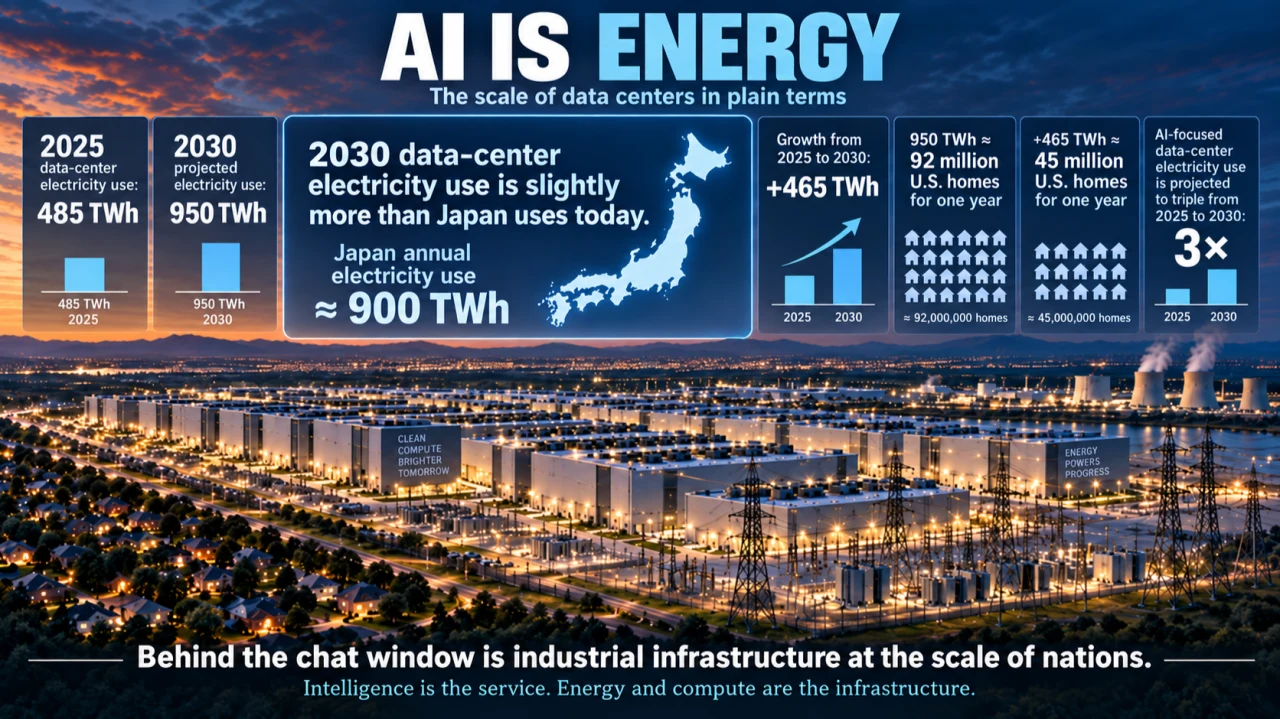
The International Energy Agency estimates that the world's data centers consumed about 485 terawatt-hours of electricity in 2025. By 2030, it expects that number to reach roughly 950 terawatt-hours—almost double in only five years—and electricity consumption from AI-focused data centers specifically is projected to triple.[4]
The IEA says 950 TWh is slightly more electricity than the entire nation of Japan consumes today.
Values transcribed from the author’s letter and cover illustration. Estimate and projection are distinguished; independent verification is pending.
| Category | Value | Cited source |
|---|---|---|
| 2025 · estimated | 485 | IEA, Key Questions on Energy and AI (2026) |
| 2030 · projected | 950 | IEA, Key Questions on Energy and AI (2026) |
Figures attributed to the IEA in the original letter, not independently verified here. This is all data-center electricity use, not AI alone. The 2030 value is a projection, not an observed outcome; do not infer a measured trend from these two points.
But let me bring that number closer to home. In 2024, all American households combined purchased about 1,483 TWh of electricity.[5] So the world's data centers in 2030 are projected to consume electricity equal to roughly 64 percent of everything used by every American household combined today. Using the average 2024 American residential customer's consumption, 950 TWh is enough electricity to supply roughly 92 million American homes for an entire year. And pay attention to the growth alone: the additional 465 TWh that data centers are expected to require between 2025 and 2030 is equivalent to the annual electricity consumption of roughly 45 million American homes.
These are not small server rooms. This is industrial infrastructure operating at the electrical scale of nations.
That comparison should help you understand what is actually being built. The little conversation window on your phone makes AI appear almost weightless. Behind that apparent magic are enormous buildings filled with accelerators consuming electricity continuously, producing heat continuously, connected to cooling systems, substations, transmission networks and power plants.
The IEA's earlier base case put global data-center consumption near 1,200 TWh by 2035—an amount equivalent to the annual electricity use of roughly 116 million average American residential customers, or about 81 percent of all electricity currently sold to the entire U.S. residential sector.[4][5]
These figures describe all data centers, not AI alone, and efficiency continues improving rapidly. But the IEA identifies AI as the principal driver of the current growth and projects AI-focused data-center electricity use to triple by 2030. That is why I say AI is Energy. Not as physics. As economy.
The thing being presented to you as disembodied intelligence increasingly requires nation-scale physical infrastructure to manufacture at scale.
And here is the part I do not want you to forget. You will be subscribing to it. That is what you do. You listen to what the Leech tells you. It has you hypnotized. Confusing the Inversion for natural behavior.
Please do not get things twisted. You are not being sold electricity directly. You are being sold access to what their privately controlled electricity-and-compute infrastructure can produce. If this ownership structure continues, that is the emerging arrangement: civilization supplies enormous amounts of physical infrastructure and energy to a comparatively narrow collection of computational factories, and citizens increasingly rent access to the intelligence those factories produce. The intelligence feels infinite. The scarce thing underneath it is not. The scarce thing is computation, computation requires energy, and computation has owners.
The Real Repercussion
Do not imagine that the first consequence of this buildout will be some conscious machine declaring war on humanity.
The first consequences will be much more ordinary: electricity strained, land reassigned, water negotiated away, utility systems reconfigured, surveillance expanded, jobs automated, public institutions tied more deeply to private computational infrastructure, and decisions about ordinary life routed through systems citizens cannot inspect or meaningfully challenge.
Look at what is already happening around the infrastructure. In August 2026, a derecho with nearly 100-mile-per-hour winds knocked out electricity across Northwest Indiana; in Gary—a predominantly Black, economically strained American city—large portions of the population remained without power for nearly two weeks. The storm caused that blackout; I will not lie to you and blame a data center for it. But look at the larger picture.
In the the same Northern Indiana regional power system, Amazon's enormous New Carlisle data-center complex had already become such a significant load that during a January 2026 grid emergency the Department of Energy ordered it to reduce its grid draw by 50 megawatts, shifting to onsite diesel generation. Then, only weeks after Gary's prolonged outage exposed just how vulnerable its residential infrastructure remained, Gary's mayor imposed a one-year moratorium on data centers, explicitly naming grid reliability, residential utility costs, water, infrastructure, emergency preparedness and quality of life as issues the city needed to understand before allowing this industry in. Gary does not even have an operating data center yet. Its government is looking at what is happening around it and asking the question before the concrete is poured.
Look south to Memphis and the warning becomes even more physical: Reuters found that xAI installed 59 natural-gas turbines for its expanding AI infrastructure without federal air permits, with pollution falling around predominantly Black communities already burdened by elevated respiratory illness; xAI and state regulators argued that temporary turbines were exempt, while the EPA and environmental groups disputed that interpretation.
Look east to Virginia, the heart of America's data-center industry, where the governor is now asking regulators to prevent families and small businesses from being charged for transmission infrastructure required by enormous new data-center loads.
You don't have to invent a conspiracy from these facts. I cannot prove that someone sat in a room and said, test this on the vulnerable first. I am asking you to recognize a pattern older than AI: when powerful systems expand rapidly, their earliest external costs often become easiest to tolerate where people possess the least money, political leverage, infrastructure resilience, or ability to leave.
That is where AMM tells you to watch.
Gary's darkness, Memphis's turbines, Virginia's fight over who pays the grid bill—these are much closer to the first consequences of the AI revolution than a conscious machine announcing that it has decided to exterminate you.
The AI itself will not kill the citizen. The infrastructure built to enable it will change what the citizen breathes, what he pays for electricity, how reliable his grid is, who controls his land and water, and how much public power must bend around private computation.
And all of this for what? Look at the children. The Leech, which grew from a civilizational logic the modern West has practiced for centuries—take the land, extract the resource, enclose the commons, convert dependence into revenue, accumulate beyond need, and call the result progress.
Corporations once petitioned states for access to markets.
We have entered an era in which states themselves have become customers, guarantors, dependencies, and assets inside networks of private power that move across borders with capital, computation, energy, and ownership. The United States is not immune to this transformation. It is being demoted and pulled into it.
IN OTHER WORDS, THE LEECH IS NOW TURNING ON ITS HOST
That is the real story and precisely why it invents a drama of a rogue machine, a digital god, an extinction event. It needs a monster to frighten you, because a frightened people will trade freedom for safety and never notice that the safety is being sold by the thing that is eating them.
AMM rejects that future. I am not asking you to spend your life raging at rich people. I am asking you to develop a different relationship with power altogether.
Stop worshiping concentration. Stop confusing accumulation with civilization. Stop waiting for the people who profit from your dependence to design your freedom.
References
IEA — Key Questions on Energy and AI (2026)
IEA — Electricity consumption by data centres, 2020–2035
U.S. EIA — 2024 electricity sales by sector
U.S. EIA — Residential customers and electricity sales
National Weather Service — August 11, 2026 derecho and prolonged Northwest Indiana outages
AP — Gary residents still without power 13 days after storms
City of Gary — September 2026 data-center moratorium
Indianapolis Star report — Amazon New Carlisle power, pollution and grid emergency
WVPE — Amazon New Carlisle air-permit violations
Reuters — xAI turbines and Black communities around Memphis/Southaven
Virginia Governor — regulators require data centers to pay dedicated transmission costs
End of letter