 The American Millennial Manifesto
Essay · The American Millennial Manifesto by Henok Ghebrechristos · · 60 min read · Claim levels: model, hypothesis
Chapter Three: The Host and the Infection
The third chapter of the manifesto. Working draft.
The American Millennial Manifesto names a moral inversion rooted in Western imperial history: the profession of principles that institutions do not allow to govern their conduct. Power announces the dignity of the human being, then reserves the right to decide whose dignity will constrain it. When that exemption is protected by law and repeated through administration, the contradiction becomes a foundation of the arrangement.
My concern in this chapter is the moral erosion of the person. I mean the weakening of your willingness to recognize harm, judge power honestly, and let another person’s humanity place a limit on what you will accept. You can remain employed, informed, and materially comfortable while this happens. The damage reaches further when you begin defending the conditions producing it and teaching others to accept them. Control has entered the formation of character.
American life did not invent this Inversion. It inherited institutions, claims upon other people, and explanations that made those claims respectable. The inheritance has been contested throughout the country’s history. Its survival depends on people continuing to administer and defend it.
You, as a person belonging to this society, are taught to earn a dignity you already possess, and to defend the arrangements that steadily erode it.
The Leech names the organized extraction this Inversion sustains when it acquires ownership, institutional authority, and the protection of the state. It is manufactured: assembled from our materials, running on our metabolism, defended by our loyalty. Chapter 2 examined its anatomy. Here I follow its dependence on the Host’s judgment. An arrangement gains a deeper hold when the people living under it supply the reasons it should be obeyed.
I need to speak directly now, and I need you to know who is speaking.
I come from a community positioned at the receiving end of this arrangement. I have also spent roughly twenty years in the United States, studying, working, building, and raising a family. This country has shaped me. I am still examining what I have absorbed, what I have defended, and what I must stop passing on. I am writing from inside the culture I am asking us to confront.
For many people whose lives have been shaped by colonization, enslavement and its inheritance, exclusion, or poverty, the distance between the promise and the conduct has never been an abstract question. These are different histories, with different injuries. They have produced knowledge that a more protected public has repeatedly had the option to set aside.
This knowledge is not a revelation. It is a burden. It is a bill we were never allowed to stop paying.
So when I turn to you, the reader who has had more room to trust the arrangement, hear the concern inside the demand. I am afraid of what you may learn to excuse in order to remain inside it. I want you to examine the distance between the person you believe yourself to be and the conduct you have become willing to defend. Care for you includes asking what your loyalty permits.
A salary can become the price of silence. Status can make an honest admission feel like a loss of identity. Fear can make obedience feel like prudence long after the particular danger has passed. These conditions matter here because they can reach into the way you judge. The injury I am following is what happens when you begin calling the surrender of conscience maturity.
This is the urgency. A public can lose the habit of requiring power to answer for its conduct while continuing to describe itself as free. The danger is present whenever belonging requires us to overlook what we know, or success requires us to make peace with another person’s degradation. I want us to recover the moral independence from which we can own this country together and change what its institutions are permitted to ask of a human being.
Who Belongs to the Country
The Host is you, me, and the United States public. Yet we are not all treated as equally American. Some people’s belonging is assumed; others are repeatedly asked to prove theirs. Consider whose account receives a hearing, whose criticism is treated as disloyalty, and who is expected to remain grateful for being allowed a place. A country can claim you among its people while withholding a meaningful part in determining its direction.
Presence, legal citizenship, social recognition, and practical authority are different things. Citizenship carries particular legal rights. It does not settle whether a person will be believed, treated as an equal, or able to obtain correction. People who lack citizenship also live under the country’s institutions and have human claims that cannot depend on how useful those institutions find them. In AMM, membership in the Host names the public living within these relationships; it is broader than the electorate.
The Host includes people before they can contribute and when they need others to carry them. A child, an older person, a person who is ill or disabled, and someone doing unpaid care belong without an economic defense of their existence. Our humanity establishes the obligation. Work and cooperation explain some of what sustains the country; they cannot be conditions for being recognized as one of its people.
The distinction matters when oppression becomes ordinary. Imagine a person whose work is welcomed while their account of mistreatment is dismissed as ingratitude. Nothing in that encounter needs to announce that they do not belong. The lesson is delivered through what they must accept to keep their place. If an institution receives their contribution while making honest objection unsafe, inclusion has been made conditional on submission.
Belonging also carries a moral demand. If your place feels secure only while another person’s account remains unheard, examine what that security requires you to defend. If your own belonging has repeatedly been questioned, you should not have to buy acceptance by becoming indifferent to someone else’s exclusion. A country becomes ours when we can tell the truth about it without surrendering our standing within it.
This account of the American Host is a focus of inquiry, not a boundary around whose life matters. People outside the United States can bear the consequences of American decisions without a vote in them. Recovering authority at home must include accountability for what is done abroad. Otherwise, the demand to own our country would preserve the same permission to make someone else disposable.
The Inheritance of the Inversion
To understand the inheritance, we need to follow the authority as well as the language. Who claimed the right to govern, possess, or profit? What account of goodness accompanied the claim? The record below follows a particular route through British colonial institutions and the American republic. It shows how moral claims and organized domination could inhabit the same public order.
In the First Virginia Charter of April 10, 1606, James I presented colonization in the language of spreading Christianity and bringing the people already there into what the charter called civility. It treated the absence of a Christian ruler as a qualification for colonial claims, assigned territory and resources to English companies, and reserved a share of precious-metal proceeds for the Crown. The document joined a claim of moral improvement to grants of property, commercial privilege, and governing power. The people described as needing improvement did not determine the terms of the grant. [1]
On September 27, 1672, Charles II granted a charter to the Royal African Company, giving it a monopoly over English trade in the specified African territory. The National Archives describes the company’s trade in enslaved Africans, gold, and ivory. This was commerce organized through state authorization. The human beings subjected to it carried costs that the commercial claim converted into another party’s opportunity. The institutional relationship matters: public authority could secure a private claim upon human life. [2]
The Inversion I am examining is present in the founding order itself. The republic’s White founding lawmakers proclaimed human equality in 1776; the constitutional settlement of 1787 nevertheless protected the return of people escaping enslavement. [3] [4] In 1790, Congress restricted eligibility for naturalization to a “free white person.” [5] These were public commitments, written into the country’s declarations and law. The nation could claim freedom as its identity while protecting domination through its institutions. Whiteness was made a legal qualification for entry through naturalization. This is a foundation whose moral contradiction has to be confronted before we describe the public as merely its victim.
The contradiction was publicly challenged. In 1852, Frederick Douglass asked what the celebration of independence meant to those still enslaved. His speech confronted the nation with cruelty that public celebration could conceal or excuse. [6] The moral problem was available to public judgment because people were already naming it. Those with power had to decide whether that knowledge would be allowed to change the arrangement.
The organization of public judgment also has an explicit institutional history. In its May 1917 Preliminary Statement to the Press, the Committee on Public Information described public opinion as a resource of war and called on the press to help cultivate national sentiment. It discussed voluntary censorship while also asserting a right to criticize officials and distinguishing military secrecy from other news. The document records an effort to organize what would be withheld, circulated, and associated with patriotic duty. It does not establish that every recipient believed the message. It does show that directing the public’s understanding was an announced government task. [7]
In 1938, the Federal Housing Administration’s underwriting manual instructed evaluators to treat changes in a neighborhood’s racial and social composition as threats to stability and property values. [8] The work passed through professional judgment: officials set the criteria, appraisers applied them, and lending decisions carried their consequences into households. Race was built into what an institution presented as prudent assessment. This provides a historical example of the head’s guarding function: trained expertise can make exclusion appear to be responsible administration.
On April 16, 1963, King’s Letter from Birmingham Jail confronted another form of protection. He criticized the White moderate who valued the preservation of order over the achievement of justice and claimed the authority to determine when someone else should become free. [9] His argument identified conduct among professed allies. The objection was that their preference for an undisturbed social order helped sustain the injury they said they opposed. Moral respectability could function as a barrier to correction.
The law did change. The Fair Housing Act was signed on April 11, 1968, prohibiting specified forms of housing discrimination. [10] That change matters because people challenged existing arrangements and obtained a new legal standard. It did not distribute already accumulated property anew. We have to examine both the gains won through struggle and the institutions through which earlier advantages continued to shape opportunity.
When I speak of a moral foundation, I mean a principle that continues to bind us when honoring it becomes inconvenient. Human dignity must constrain what we are willing to do for wealth, security, or national advantage. A declaration of equality means little as a moral foundation if those with power retain the authority to decide whose humanity creates an obligation and whose humanity can be set aside. The West has produced moral philosophies, religious commitments, and movements that challenged domination. The failure I am examining is the repeated exemption of power from the principles it publicly invokes. A civilization cannot establish its moral standing by reciting values that its institutions are permitted to violate.
The relative youth of the republic cannot by itself explain this failure. A country’s age does not establish its conscience. The foundational question is what its governing commitments require when dignity conflicts with advantage. Douglass’s challenge also belongs to American history. The people who opposed domination were part of the country, even when its institutions refused their judgment. Building a foundation requires carrying that demand into the conduct of power, including the power held by people we admire.
This history is why I cannot introduce the Host as an innocent public newly encountering the costs of power. The public has contained people subjected to domination, people protected by it, and people who challenged it. Those positions can overlap within a life. A serious account must hear the communities that recognized the injury early and follow the authority that kept their knowledge from becoming correction.
The moral inheritance concerns the standard a person learns to apply. A principle may be recited as universal while its protection is withheld from the people whose subordination makes an arrangement profitable or respectable. The danger to the Host begins when that exemption becomes ordinary judgment: when the public learns whose pain requires an answer and whose pain may be explained away. We have to follow the inheritance into those decisions.
The Anatomy of the Host
The Host is the United States public. The Leech draws on our work, necessities, attention, and cooperation. Its power also depends on what we agree to administer and defend. A person can be injured by an arrangement while helping protect it from correction. This anatomy follows that relationship: what is taken from people, what they are offered for cooperating, and what they learn to require of one another. You may recognize yourself in more than one position.
AMM applies my systemic understanding of society and my process-oriented understanding of individual life. Institutions establish conditions. We interpret those conditions, adapt, and act. Our conduct then helps reproduce or change the arrangements shaping us. Following that process requires us to distinguish the people, the organization of extraction, and the logic through which extraction becomes acceptable.
The Leech and the logic it carries
The Leech has a composition. In AMM, its two strategic centers are the Security-Industrial Oligarchy and the Technological-Platform Oligarchy. The first brings together defense contractors, intelligence firms, energy interests, specialized financiers, consultants, and political networks organized around American state and geopolitical power. The second brings together dominant platforms, computing and artificial intelligence infrastructure, and the financial interests organized around control of digital access, data, and attention. These names identify concentrations of power examined in Chapter 2. They do not make every worker within those industries equally responsible for their decisions.
Its institutional body consists of connected businesses, financial institutions, platforms, contractors, and intermediaries joined through ownership, financing, contracts, infrastructure, and legally protected claims. Wealthy owners and heirs whose position depends on commanding or inheriting those claims belong within this anatomy. The executive who determines the terms and the worker who must accept them occupy different positions, even when both receive income from the same institution.
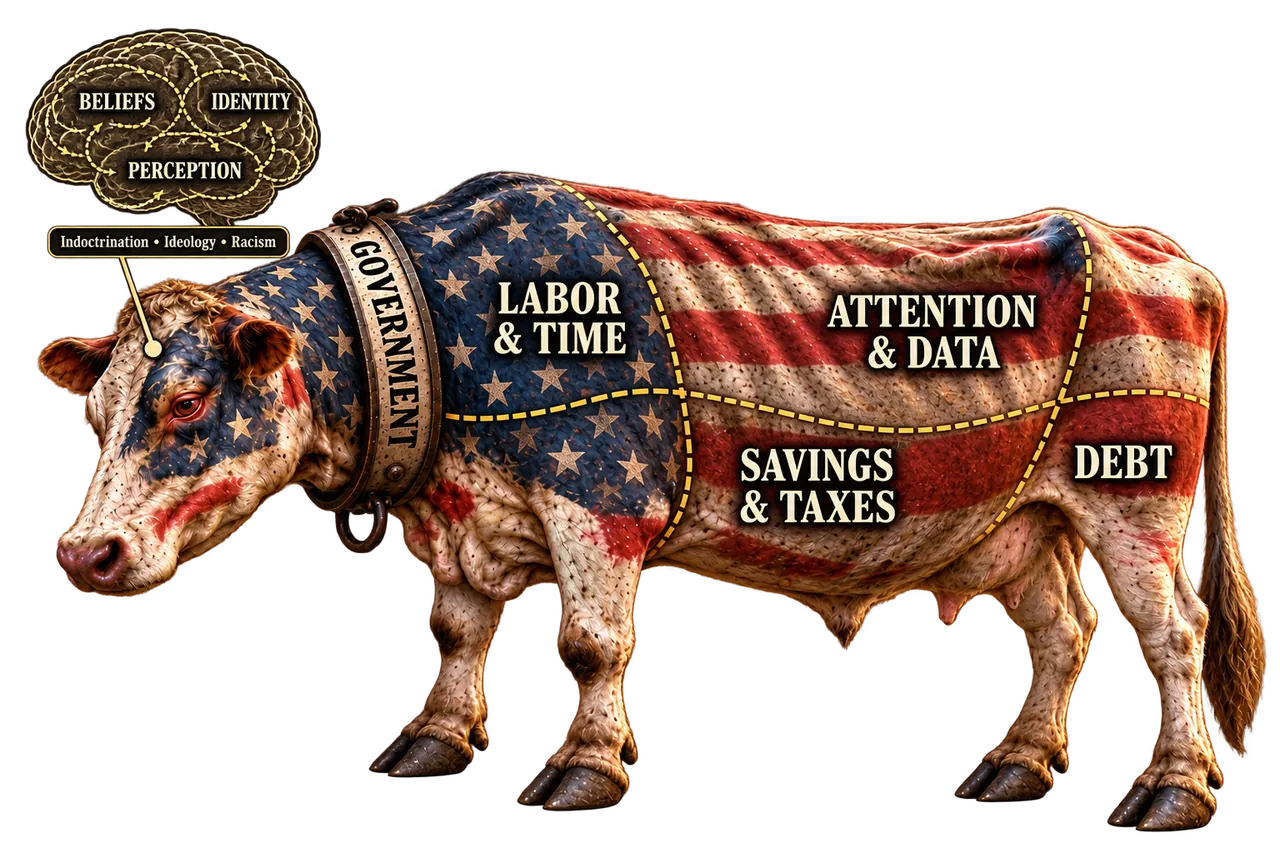
The four feeding interfaces describe how that body reaches the public: digital access; financial administration and asset ownership; legal control of knowledge; and private claims upon public necessity. Government is a principal attachment point because it makes and enforces laws, awards contracts, supplies funding, and protects claims. Culture is the enabling tissue when it teaches people to accept these terms as natural, necessary, or deserved. The metaphor directs us toward identifiable relationships. Whether a particular institution is extracting requires evidence about its authority, its contribution, the dependence it creates, and the costs it transfers.
The pathogen is the extractive logic of domination. It teaches that fear can be settled through control, that security requires accumulation without end, that another person’s dependence is an opportunity, and that position establishes worth. Infection is the process through which a person learns to apply that logic. A cultural lesson becomes an expectation; the expectation guides a decision; the decision helps teach the next person what to expect. The Leech can carry and reward this logic while drawing its personnel and protection from the society it feeds upon.
The relation has a material, a political, and a moral dimension. Ownership gives people claims over resources and work. Public authority can secure those claims. The moral dimension concerns the permission people learn to give: whose interests appear natural, whose objections appear unreasonable, and whose suffering can be accepted as the cost of keeping the arrangement. The Leech acquires protection when these judgments are supplied by the Host itself.
Class and the head of the Host
Within the Host, class describes unequal access to resources and unequal room to refuse. Income pays current expenses. Wealth provides reserves, property, and claims that can survive the loss of a job. Institutional authority permits a person to make decisions others must live with. These can accumulate in the same hands, but they can also separate. A well-paid specialist may have little control over a firm. A public official with modest personal wealth may control an important permit, contract, or enforcement decision.
The head of the Host sits where those decisions acquire direction and legitimacy. It includes people who translate institutional objectives into budgets, employment rules, technical systems, legal positions, and public explanations. Their professions do not establish wrongdoing. The guarding function appears when they use their discretion to keep an extractive arrangement beyond effective correction: concealing a known cost, discrediting a substantiated complaint, punishing an objection, or describing an avoidable injury as the necessary price of order.
We must keep this head distinct from the Leech’s ownership and command. A controlling owner or executive who sets the extractive terms belongs within the Leech’s anatomy in that capacity. A manager or professional who implements and protects those terms may function as an intermediary within the Host. One person can occupy both positions. The distinction follows what they control. Moving a powerful executive into the language of public vulnerability must never reduce their accountability for decisions they can change.
An intermediary can be a bridge. A person who understands an institution’s language and the lives affected by its decisions can carry an injury into a room the injured person cannot enter. That knowledge can also be used to police the entrance. The bridge becomes the gate when access depends on making a complaint harmless to the institution before anyone with authority will hear it. You may explain that the person must be more patient or more grateful. Examine what those conditions accomplish. If the evidence remains unanswered while the person is trained into silence, your mediation has become protection for the arrangement.
The head guards the Leech most effectively when it makes submission respectable. A manager can turn a question about harm into a question about attitude. A professional can use technical language to make an avoidable injury appear beyond ordinary judgment. A respected intermediary can ask the injured person to protect the institution’s reputation before the institution has answered the complaint. In each case, authority is being used to determine which moral questions may reach a decision.
Benefit dependence and belonging
Protected beneficiaries form a wider circle. A homeowner, investor, pension holder, or well-paid employee may receive advantages without directing the institution producing them. Benefit creates a reason to examine the arrangement and a possible motive to defend it. It does not establish that every beneficiary has defended it. A retirement account with a small holding does not confer the authority of a controlling shareholder. The relevant question is when a person uses the influence they do possess to preserve benefits by closing other people’s opportunities.
People with little room to refuse remain central to the Host. An hourly worker, a heavily indebted professional, a tenant, or a migrant dependent on an employer can understand an injury while facing severe costs for challenging it. Their situations differ, and none is fully described by occupation or income alone. Children, older people, people who are ill or disabled, and unpaid carers belong fully to the public. Receiving care gives a person a claim upon our responsibility, regardless of their ability to supply marketable work.
Authority and responsibility within the model
| Position | Source of power or dependence | What accountability examines |
|---|---|---|
| Leech ownership and command | Control of extractive claims and terms | Decisions, benefits, imposed costs, and repair |
| The Host’s head | Delegated authority and public credibility | How discretion permits harm or enables correction |
| Protected beneficiaries | Assets, income, status, or preferential access | Whether influence is used to protect exclusion |
| People with constrained options | Dependence on wages, housing, care, or permission | Actual freedom to act and support needed to refuse |
These are overlapping relationships, not permanent kinds of people. A nurse can be both a tenant and a supervisor. A manager can protect a worker from retaliation or enforce it. An affluent resident can open a neighborhood to others or organize to keep them out. The same position can be used to obstruct extraction. This is why the anatomy must record conduct as well as rank.
The guard is identifiable through a sequence: a person has authority, receives evidence of harm, has a feasible opportunity to respond, and uses that authority to prevent correction. Intentional deception and retaliation deserve especially direct accountability. Failure to act requires examining what was known and what action was possible. A comfortable position increases the questions a person must answer; a difficult position does not make every harmful act unavoidable. The standard remains specific enough to investigate and demanding enough to reach people who have learned to call their own discretion powerlessness.
Race remains part of this anatomy because authority and protection have a history. In the Census income table for 2025, White non-Hispanic householders accounted for 61.5 percent of all households and 71.7 percent of households in the top five percent of money income. These are household classifications, not measurements of conscience. They help locate the distribution of advantage; responsibility still has to follow what people do with the discretion and protection they possess. [11]
Race crosses these relationships and shapes their history. Black, Asian, White, Native, Latino, multiracial, and other communities contain people with different resources and responsibilities. Brown is a meaningful identity for many people, but it is not one consistent statistical category. Migration history and citizenship are additional dimensions that cut across race. The divisions drawn on the Host show differences through which people can be separated; they must not turn whole communities into organs assigned a single moral character.
The question addressed to the head is therefore concrete. When someone brings evidence that an arrangement is injuring people, do you help make the evidence answerable, or do you teach the person to stop bringing it? Your role may give you more room to refuse than the person who raised the concern. That room creates responsibility. The moral failure begins when you use it to protect the arrangement from correction.
The Attack on Judgment
By an attack on the mind, I mean pressure directed at the capacities through which a person recognizes reality, examines authority, and decides what is acceptable. It can operate through a deliberate campaign of deception, through penalties attached to truthful speech, or through repeated rewards for defending a preferred account. Its success has to be examined in what people become willing to say and do. The mechanism is control through the organization of judgment.
The pressure does not have to reach you as an instruction to become dishonest. It can arrive as advice about being realistic. You are told which question will damage your prospects, which injured person is difficult, which contradiction must remain outside the meeting. The terms may sound reasonable one at a time. Together, they can make the institution’s continued comfort a condition of what you are allowed to acknowledge.
There are deliberate acts within this process. A person can knowingly suppress a record, punish a truthful objection, or repeat a claim they know to be false. Other participants reproduce a rule they have learned to regard as normal. We should establish intention from the decision and its evidence. A culture can train people to police one another without every participant understanding the larger effect. That is part of what makes the process durable.
Independent judgment requires the freedom to examine reasons and to revise a conclusion. It includes the possibility that an authority is right and that you are mistaken. The attack occurs when status, threat, or belonging is allowed to settle the question before the evidence can. Once that rule is accepted, your intelligence can be put to work defending a conclusion you no longer feel free to reconsider.
Making Worth Conditional
You were born valuable before you produced anything. Your profession describes something you do. Your credentials describe something you have learned. Your income describes what an arrangement pays you. None of these creates the human being who deserves care. A child does not arrive owing the world proof that the resources required to keep them alive will be a good investment. The same dignity belongs to the adult that child becomes, including the adult who fails, becomes ill, or needs help.
An extractive culture reverses this order. It makes recognition conditional on performance, then encourages you to experience the condition as natural. Notice how easily a conversation about someone's life becomes a conversation about their position. What do they do? Where did they study? How much have they accumulated? These can be reasonable questions. The injury appears when their answers determine the amount of humanity we are willing to recognize in the person answering.
The habit can turn inward. A professional setback becomes a verdict on the whole self. Another person's achievement feels like evidence of your inadequacy. Jennifer Crocker and Lora Park describe how pursuing validation in domains on which self-worth depends can carry costs for learning, relationships, and autonomy. [12] Their analysis helps explain a particular vulnerability: when achievement must establish your value, an ordinary mistake can threaten much more than the task at hand.
Consider what this bargain asks of you morally. You may tolerate humiliation because the position allowing it also certifies that you matter. You may dismiss an injured coworker because taking their complaint seriously would require examining what you have accepted. You may struggle to offer someone unconditional respect while denying it to yourself. In each case, the question of human treatment is displaced by the question of whether someone has earned better treatment.
AMM begins with a different obligation. We can assess the quality of a person's work, hold them responsible for misconduct, and distinguish competence from incompetence while recognizing their standing as a human being. Accountability concerns what a person does and what repair requires. A culture becomes morally damaged when it makes dignity another reward that the powerful may distribute or withdraw.
Conditional worth gives control an intimate point of entry. If losing a title feels like becoming less of a person, you have more than a job to protect when the institution is questioned. Its approval has become part of how you establish your right to matter. Then a request to overlook harm can arrive with the force of a threat to your identity. Recovering intrinsic dignity removes that permission: no institution acquires your conscience by recognizing your ability.
Teaching You What May Be Said
Imagine a meeting in which you raise a concrete concern. The answer addresses your tone, your attitude, or your failure to understand how things work. Your evidence remains unanswered. After enough encounters of this kind, you may begin editing a question before anyone else hears it. Eventually, you may hesitate even to formulate it. The authority in the room has entered your private reasoning. You start asking whether a thought is permissible before asking whether it is sound.
The injury can deepen when an institution denies what its own record shows. The exclusion is the first injury. Being told the exclusion did not happen is the second. Now you must defend your account before the harm can receive a hearing. The head of the Host guards extraction when it turns a documented complaint into a judgment against the person bringing it. Recovery requires a process that can examine the evidence and correct the decision without making belonging depend on silence.
James Detert and Amy Edmondson examined learned beliefs about speaking up in four studies of what they call implicit voice theories. Their work describes rules people take for granted about when questioning an authority is risky or inappropriate. This is a useful account of self-censorship: a person can bring a learned expectation of danger into a new situation, before receiving a new prohibition. The research concerns workplace voice; the wider account of public control developed here is my application of that mechanism. [13]
Silence can make this damage feel universal. You know your own reservations, but you see only other people's public compliance. Research by Deborah Prentice and Dale Miller documented a related error in college drinking norms: students often believed their peers were more comfortable with campus practices than the students themselves were. [14] Applied cautiously to institutional life, the lesson is useful. A room full of quiet people is insufficient evidence that everyone agrees. Treating it as agreement can leave each person feeling alone with an objection others may share.
The change is morally consequential when silence begins to decide what deserves concern. You first withhold a truthful sentence because saying it feels unsafe. Later, you may dismiss the subject because acknowledging it would bring the unsafe sentence back. A limit on what you can say has begun becoming a limit on what you will examine. The institution receives the benefit of an objection you have learned to interrupt yourself.
Honest judgment requires room to test both authority and yourself. Your discomfort deserves examination; it does not settle every question. A respected institution may be right, and a dissenter may be mistaken. What matters is whether reasons can be examined without a person's status deciding the result in advance. That freedom is damaged when every exchange becomes a contest over who is entitled to speak.
Making Harm Respectable
Something similar happens when preserving a valued belief becomes more urgent than examining it. Ziva Kunda's account of motivated reasoning describes how a desired conclusion can influence which information people retrieve and how they evaluate it, within the limits of what they can plausibly justify. [15] Intelligence offers no automatic escape from this difficulty. A capable mind can produce an elaborate defense of a conclusion it has become afraid to lose.
Over time, the temptation is to make the contradiction disappear by changing the judgment. You begin calling an avoidable harm necessary. You describe the people absorbing it as difficult, unrealistic, or responsible for their own misfortune. Albert Bandura identified several ways people disengage moral restraint, including obscuring consequences, shifting responsibility, and giving harmful conduct a respectable description. [16] The relevance here is the relief these explanations offer: a person can continue cooperating while preserving a favorable picture of themselves.
Listen to what an explanation asks you to remove from view. A decision described only as necessary may leave out the person who chose it and the alternatives they rejected. A person described as difficult may be the one who keeps bringing the evidence. A reference to procedure may settle who signed the decision while leaving unanswered whether the decision should have been made. Language becomes a means of control when it supplies closure in place of an answer.
This is a corruption of moral reasoning. Your ability to explain becomes detached from your obligation to examine. You can learn to produce a polished defense of conduct you would recognize immediately if someone else’s institution performed it. The explanation protects your standing while narrowing the conditions under which another person’s experience is allowed to matter.
When Compliance Becomes Character
There is another injury familiar to people who still notice. You recognize a contradiction and continue participating because your life depends on the arrangement. Your family needs the income. Leaving may carry consequences you cannot responsibly ignore. You tell yourself that you will endure the present compromise until you have more room to act. Sometimes that is a necessary judgment. A person choosing among constrained options carries a different responsibility from the person imposing those constraints.
Before you act, a direction is already forming. In this situation, it can become organized around preserving your position before you have fully considered the question. You listen for danger, anticipate the approved answer, and use your intelligence to remain within it. Fear has begun governing the inquiry when protecting an identity or livelihood makes a conclusion unavailable for examination. That does not make immediate caution a moral failure. It gives us a way to distinguish a necessary limit on today's action from a limit you have begun imposing on what may be thought.
There is a consequential passage between withholding an objection and revising the judgment that produced it. At first, you may tell yourself that you know the act is wrong but cannot afford to challenge it. The contradiction remains alive. Later, defending the act can make continued participation easier. You call it necessary, question the person harmed, or decide that anyone who objects has failed to understand the world. Now the bargain is receiving a moral defense from the person it constrained.
Research by David Welsh and colleagues examined gradual ethical transgression across four studies involving repeated decisions. They found evidence that small, escalating departures could increase moral disengagement and subsequent unethical behavior. The authors also emphasized the short time frames and relatively low stakes of their studies. These findings identify a possible process; they do not establish the moral condition of a country or make deterioration inevitable. They give us a reason to examine the small exceptions through which a person becomes comfortable with a larger wrong. [17]
The cost is that conscience becomes something to manage. A question that once demanded an answer becomes an irritation to suppress. You may even resent the colleague who keeps asking it, because their persistence reopens a conflict you have worked hard to close. The institution no longer has to supply every defense. People who need to remain inside it begin supplying defenses for one another.
The change can become visible when someone newer to the institution notices what you once noticed. Their question irritates you. You know the cost of raising it, and you may believe you are protecting them by teaching them to stop. But consider what your advice contains. Are you helping them preserve their judgment while choosing a safe response, or are you teaching them that the judgment itself is naive? Care can become the language through which compliance is passed on.
I do not want to romanticize the suffering of the person who refuses this accommodation. Seeing a contradiction clearly can leave someone lonely, angry, and unsure where to go. Their distress deserves a serious response. A culture that answers every moral objection with advice about attitude teaches people that honesty is a personal defect. It can wear down the very capacity for correction that an institution needs in order to deserve trust.
A familiar explanation can protect itself through the relief it offers. It reduces the conflict, so you return to it. You notice evidence that keeps the explanation intact and become less willing to inspect what would disturb it. The consequence of one accommodation helps prepare the next. Experience shapes your interpretation; your conduct then helps reinforce the expectation through which the next experience will be received. You can begin examining that process when you notice what you are repeatedly protecting and what acknowledging it would require you to change.
Moral erosion is therefore more than a single failure to act. It concerns a developing permission to treat the failure as reasonable and to demand the same accommodation from others. This is how control can enter character. A rule once imposed from outside becomes a standard you carry into the next meeting, the next relationship, and the next generation. Recognizing that process creates a place from which it can be interrupted.
In Power We Trust
You inherit a picture of the world before you have the means to examine it. The adults around you name what matters, explain what happened, and show you who deserves respect. School gives you an account of your country. Work teaches you which qualities receive recognition and which questions create trouble. Even the language available for describing your experience arrives through other people. Each of us begins inside a limited understanding. A cultural bubble forms around the explanations we encounter and the lives we are given an opportunity to see.
There is something inevitable about this beginning. A child depends on knowledge that other people have carried forward. Culture makes learning and cooperation possible. The difficulty grows when the received account loses its openness to correction. Familiarity begins to serve as evidence. Agreement among the people closest to you makes an explanation feel complete, while experiences outside that circle become easier to dismiss. You can spend years developing confidence within a picture whose boundaries you have scarcely noticed.
The bubble becomes harder to leave when its explanations also secure your belonging. A belief can carry your family's approval, your professional identity, or the promise that your sacrifices will eventually be rewarded. Examining it may mean admitting that someone you love was mistaken or that an institution you served does not deserve the confidence you placed in it. The cost of correction becomes personal. You begin looking for an explanation that will preserve your place among the people whose recognition matters to you.
Ego makes that correction more expensive. By ego here, I mean the investment in appearing competent, justified, or superior, and the fear of losing that standing. You may experience an unanswered question as an exposure of your inadequacy. You may defend a judgment because changing it would require an apology. When being wrong threatens your worth, protecting the explanation can feel necessary for protecting yourself. Arrogance develops when confidence is used to close an inquiry that the evidence still leaves open. The person offering correction becomes an obstacle to the image you need to maintain.
Consider how predictable your own reactions can become. You may know whom to distrust before hearing their argument. You may have an explanation ready for someone’s suffering before learning what happened to them. The familiar phrases arrive quickly, carrying the reassurance of everything you have heard repeated. You experience the conclusion as your own because you recognize it. But recognition deserves examination. Where did this belief come from? What would make you revise it? Could you apply it consistently to someone you admire? Indoctrination becomes difficult to recognize when the habits it teaches feel like independent judgment. A person can sincerely believe they are thinking freely while repeatedly defending assumptions they have never examined.
The Western bubble I am examining gives this ordinary human vulnerability a particular story to protect. The story associates wealth and power with superior judgment, treats the country's institutions as evidence of its moral standing, and gives its account of freedom authority over lives that contradict it. I have had to examine my own attachment to this story. It becomes difficult to question when belonging depends on defending it and success seems to confirm it. A moral principle must continue to create an obligation when the person harmed stands outside the circle from which we receive approval.
Watch what happens when an admired person mistreats someone with less status. Before examining the conduct, do you search for the explanation that will preserve your admiration? Perhaps they are under extraordinary pressure. Perhaps greatness requires a difficult temperament. Perhaps the person complaining simply cannot handle the environment. Now imagine the same conduct coming from someone you already consider unimportant. Does your patience disappear? The difference reveals how much moral credit you have attached to rank.
This is what I mean by the inward creed, In Power We Trust. The creed is practiced whenever success becomes its own justification. A large fortune is treated as evidence of superior judgment beyond the work that produced it. An executive title is allowed to settle a question the executive has not answered. A leader's ability to dominate a room is mistaken for the quality of the reasoning offered there. Competence deserves recognition where it is demonstrated. Reverence asks you to stop checking.
For the person who has been humiliated, identification with power can become especially tempting. You imagine reaching a position from which nobody can dismiss you again. In that imagined future, the humiliation finally ends because you stand above the people who inflicted it. But what happens to your understanding of freedom if safety always requires somebody beneath you? You may begin defending the hierarchy because you still hope it will eventually protect you.
The emotional investment is difficult to surrender. Criticism of a wealthy idol can feel like an attack on the life you hoped to have. Criticism of your employer can threaten the identity you built around being selected by it. You are defending more than an institution. You are defending a story in which your sacrifices will be redeemed. The Leech acquires protection when examining its conduct feels like admitting that years of your own life were wasted.
Those years remain yours. Your effort, skill, and care retain their value even when the institution receiving them behaves badly. You do not owe an employer your conscience because it recognized your ability. You do not owe an admired leader your judgment because they once gave you hope. The damage deepens whenever gratitude is stretched into an obligation to excuse harm.
A promise of success measured by standing above others cannot be fulfilled for everyone. A top ten percent can contain only ten percent. Shared sufficiency can be a civilizational goal. Universal superiority cannot. The question for a cultural revolution is what we are preparing people to seek. We can honor skill, discovery, and contribution while making security and dignity available beyond the winners of a competition. That changes what success is allowed to demand of another person’s life.
Power gains a moral exemption when its survival is allowed to decide what counts as right. You can then experience an accurate criticism as an attack on everything that gives your life meaning. This is why the examination has to reach deeper than information. A person may possess the facts and still organize their judgment around keeping those facts from changing their allegiance.
Death by Erosion
The smaller life I am describing is a life with less moral room. You become less available to truth when truth threatens your place, less available to another person when their suffering creates an obligation, and less able to admit an error when admission endangers your standing. The loss can be quiet. Your work can improve, your income can rise, and your reputation can remain intact while the range of things you are willing to recognize contracts.
This is how institutional pressure can become personal erosion and then protection for the institution itself. A person can remain productive while losing the freedom to live according to what they know. The injury reaches the soul: the capacity to speak honestly, to love without calculating advantage, and to recognize suffering without first checking whether acknowledging it threatens your position. When I speak of a slow death, I mean this wearing away of a life from within. The harm you endure deserves attention. So does the harm you become willing to administer.
This is the distinction between the Infection and the erosion it can produce. Infection names the learned permission to make dignity conditional and domination reasonable. Erosion names the accumulating loss of agency, honesty, and availability to others that can follow as those permissions organize a life. Neither term places a person beyond recovery. A cultural diagnosis has to preserve the possibility of revising the conduct it identifies.
The transmission I am examining occurs through teaching, institutional rewards, repeated explanations, and the penalties attached to dissent. Later generations and newcomers of any background can learn to defend arrangements they did not create. They can also question and resist them. Mental illness is a different matter; it is neither evidence of moral failure nor a measure of agreement with this book. A distressed person may judge carefully, and an outwardly successful person may excuse serious harm.
Pain and erosion must be distinguished. A distressed person may be preserving an honest objection under pressure. A comfortable person may have learned to excuse the harm that protects their comfort. My concern is what becomes of conscience in either life. The question is whether you remain willing to let the truth change what you do, especially when the truth interrupts an advantage or exposes a loyalty you have defended.
Power and the Invitation to Cruelty
Look at a public decision proposed while I am writing this chapter. On 8 October 2026, the Pentagon announced plans to livestream the firing-squad execution of Nidal Hasan, convicted of killing thirteen people at Fort Hood in 2009. The execution was scheduled for 3 December 2026. As of this chapter’s 14 October revision, it remains a future event. The announcement is the decision being examined here. [18]
Hasan must answer for the people he killed and the harm he caused. Those harmed, and their families, deserve sustained care and support. AMM is grounded in accountability and rehabilitation: facing the harm, taking responsibility, protecting others, contributing to repair wherever possible, and preserving the possibility of change. A person’s worth does not disappear when that person causes harm.
AMM rejects judgment that places a human being beyond care. My objection begins with execution itself: it ends the possibility of rehabilitation. The proposed broadcast adds a public spectacle to that decision. We have to examine what officials are asking the audience to accept about human worth and state power. A person’s crime cannot relieve an institution of the obligation to answer for its conduct.
I see a danger here that reaches into the audience. Real suffering can become an opportunity to acquire allegiance around a demonstration of force. Public anger can be turned toward admiration for the institution administering punishment. The capacity to destroy can begin standing in for the capacity to deserve trust. This is my interpretation of the danger; the announcement by itself cannot tell us what every viewer would feel or prove that the public has accepted it.
There has, in fact, been opposition. Archbishop Timothy Broglio, who oversees Catholic pastoral services to the US military, condemned the proposed livestream. [19] That objection matters to this chapter because public judgment remains contested. The Host contains people who excuse power, people who question it, and people still deciding what they believe. Recovery depends on preserving the space in which a moral objection can be heard.
The moral question reaches the invitation itself. What response is the audience being encouraged to practice? Does the display help people understand responsibility and repair, or invite them to experience the destruction of a human being as reassurance that power is good? An announced broadcast cannot tell us what every viewer will feel. It does give us a concrete public decision to examine before the audience is assembled.
The same discipline belongs in ordinary life, where the stakes and the acts are different. The question is whether allegiance is deciding what you are allowed to examine. You excuse humiliation because an admired leader inflicted it. You dismiss a colleague’s evidence because acknowledging it would threaten your position. The repetition can teach you to experience another person’s injury as reassurance that you still belong among the protected.
This is what I mean by death by erosion. A living person gradually loses room to speak honestly, to love without calculating advantage, and to acknowledge suffering without first checking the cost to themselves. The Leech acquires protection inside the Host when people begin enforcing those conditions upon one another. Love does not cull you slowly and call it success.
This is what I want the reader to recognize as moral erosion: becoming easier to govern through the exceptions you grant to your own principles. The exception may concern a condemned prisoner, an unpopular coworker, a foreign civilian, or a neighbor assigned to an enemy category. The standard is tested precisely where care brings you no approval. Your humanity is implicated in what you become willing to celebrate.
The Host Polices Itself
The Host is the people, and its condition is inseparable from the character of the individuals who compose it. By character, I mean how you judge and act, especially when honesty, compassion, or fairness costs you something. The larger order enters ordinary life through these decisions. An employee treats rank as proof of intelligence. A parent teaches a child to measure human worth by income. A citizen excuses conduct in an admired leader that would disgust them in a neighbor. Each judgment helps establish what others will be expected to accept. What you have learned to call normal becomes part of the world another person must live in.
A damaged sense of worth can seek relief in a group that promises significance. The group offers an account of why you have been overlooked and identifies the people responsible. It may give you companionship and a language for suffering that had been difficult to explain. Those are powerful gifts. The danger begins when keeping them requires you to surrender your judgment about anyone outside the group.
Now another person's party, religion, accent, or place of birth can arrive before the person does. The category prepares your response. You hear a position they have not stated, assign motives they have not expressed, and decide how much their suffering should concern you. Political differences can involve real conflicts over rights and responsibilities. The psychological damage occurs when belonging licenses you to stop examining the particular person or claim in front of you.
Shanto Iyengar and Sean J. Westwood's research on partisan hostility found that party cues could influence judgments and behavior even outside explicitly political decisions. [20] That finding matters here because a division can spread beyond the argument that supposedly justifies it. A citizen becomes someone you would avoid, distrust, or disadvantage before you know how they conduct themselves. The possibility of a shared public life contracts.
The Infection is visible when you demand evidence of an opponent's suffering while accepting an ally's grievance immediately. It is visible when cruelty becomes satisfying because the person receiving it belongs to a despised category. At that point, injury has become entertainment or reassurance. You can feel morally certain while your capacity for fair judgment deteriorates.
The Host is wounded through these relationships. Families become places where people rehearse approved positions or avoid speaking honestly. Neighbors become symbols in conflicts they did not create. A group may offer intense belonging while leaving its members increasingly unable to relate beyond its boundaries. The Leech benefits whenever hostility among people makes accountability for power harder to sustain. Recognizing that benefit does not require pretending that every conflict is fabricated or every side bears equal responsibility.
This is where the divisions drawn across the Host matter. In the cattle metaphor, the cuts represent lines along which the public can be divided and set against itself: party, race, class, citizenship, faith, generation, and cultural allegiance. They are separate from the feeding interfaces, which describe the institutional means of extraction. The image represents how people are treated as something to portion and use. Their lives exceed the uses assigned to them.
The histories behind those divisions are real. So are disputes over wages, property, rights, recognition, and repair. Calling them all fake would erase the very injuries the chapter asks us to recognize. The manufactured claim is that a whole category of people is naturally your enemy, and that defeating them should take precedence over examining the power governing your life. Whether a particular conflict has been deliberately manipulated must be established. An institution can also benefit from and amplify an existing hostility without having invented it.
The same discipline can operate among people who consider themselves compassionate. A group can punish an honest question because the question complicates its account of itself. Members can learn to recognize the approved vocabulary while refusing to examine the conduct it describes. The moral test belongs to the group’s treatment of truth and of people with less power. Every movement, including one formed around this manifesto, must remain answerable to it.
For others, protection takes the form of cynicism. Expecting nothing seems safer than risking another disappointment. Every act of generosity conceals an angle; every public commitment is theater. Suspicion can detect real wrongdoing, but suspicion treated as a complete explanation also closes inquiry. A person who already knows that everyone is corrupt has little reason to distinguish a trustworthy effort from a fraudulent one. Their capacity to participate shrinks with their capacity to trust.
Cynicism can provide another accommodation. If everyone is assumed to be corrupt, you no longer have to distinguish a necessary compromise from a wrong you could stop defending. Contempt can begin to feel like moral independence while conduct remains unchanged. The task is to recover discrimination: to recognize a real injury, identify a trustworthy act, and remain capable of an obligation that offers no protection for your image.
Your disappointment with an employer can coexist with trust in a coworker. Your anger at a government can coexist with a commitment to your neighbors. These distinctions preserve possibilities for action. If every person becomes another version of the power that injured you, you will have difficulty recognizing the people with whom you could begin changing its conditions. The task is to make your judgment more discerning while retaining the capacity to encounter someone who has not yet earned your suspicion.
What the Children Inherit
Look at the children learning to live among us. They hear what we say about kindness, but they also observe who receives our patience. They see the different treatment given to the powerful and the inconvenient. They notice whether a parent's apology is possible, whether an adult's embarrassment matters more than a child's account, and whether mistakes can be discussed without humiliation. These ordinary encounters are part of the moral education a household provides.
Imagine a child whose achievements receive close attention while their inner life receives what time remains. The adults may love the child intensely. Their fear for the child's future may be sincere. Still, a question about what the child enjoys can keep turning into a question about where the interest will lead. The child is preparing for a life in which every capacity must justify its usefulness before it is allowed to develop.
Or imagine the child who is taught to obey someone because that person is in charge, even when the child has identified a contradiction. We can explain responsibility, set boundaries, and protect children while taking their questions seriously. When authority requires the denial of what a child can plainly observe, obedience comes at the expense of trust. The adult has asked to be believed while making honest examination unsafe.
This is how the Infection can pass through love that has become governed by fear. We want our children to be safe, so we prepare them to survive the standards that have injured us. We teach them to become difficult to dismiss. Too easily, we leave unexamined the rule that permits anyone to be dismissed as a human being. A civilization must answer for what it teaches children to accept about themselves and about people with less power.
The child receives many early lessons before having the means to inspect them. A repeated experience of being valued only when impressive can later become an expectation that care must be earned. A parent who can admit a mistake gives the child another experience to carry forward: correction can happen without the loss of belonging. What you do repeatedly helps teach the child what to expect from truth, dependence, and authority. Love is expressed partly through the conditions in which another person is allowed to learn.
This is the moral sense in which I argue that a society can consume its own foundation. It teaches children to protect authority from questions, then expects adults capable of holding authority accountable. It rewards the appearance of success while excusing the conduct used to obtain it, then asks for integrity. The contradiction enters the child through ordinary encounters long before it becomes a public argument.
Watch what happens when a child identifies an adult’s mistake. The response teaches a rule about the world. An honest acknowledgment allows authority and correction to coexist. Humiliation teaches the child to protect rank from truth. We pass on our relationship with power through such moments. A cultural revolution has to reach the conduct children can see, including the conduct we excuse in ourselves.
Seeing One Another
A common public life cannot require Black Americans to forget racism, migrants to suppress what exclusion has taught them, or any person to treat mistreatment as the price of unity. Nor can we know a White, Asian, Latino, Native, or mixed-race person’s judgment before hearing it. Racial categories contain differences of class, age, faith, experience, and power. We have to be precise enough to recognize an injury and open enough to learn who the person in front of us actually is.
Seeing one another requires more than placing every community in the same photograph. A Black American naming an injury must not be asked to soften the account so that a more protected listener can remain comfortable. A White American examining an advantage they received needs to follow what it permits, what it costs others, and what can now be changed. Neither task can be completed by assigning a single character to everyone in a racial category. Responsibility becomes concrete when the person with authority can identify a correction and make it.
For a migrant, belonging must leave room for gratitude and criticism in the same life. Gratitude does not create a debt of moral silence. No one should have to demonstrate loyalty by overlooking another community’s injury. The same standard applies when an Asian American’s achievement is used to dismiss someone else’s account of exclusion, or when a Latino family’s work is welcomed while its right to belong remains under suspicion. These are questions to bring into conversation, with room for the person to describe what they have actually experienced.
Native nations require recognition beyond a place in the country’s list of racial groups. Federally recognized tribes have a government-to-government relationship with the United States and retain certain inherent rights of self-government. [21] That relationship creates questions about land, authority, and obligations that a general invitation to celebrate diversity cannot answer. Seeing one another here includes respecting the institutions through which a people speaks for itself.
These examples should open a conversation about experience. Race, class, age, citizenship, faith, and personal history can change how the same institution is encountered. Ask who has the freedom to object and who may lose housing, income, or permission to remain. An injury can be understood across those differences without pretending that the differences have disappeared.
Begin a difficult conversation with something that happened. Give the other person room to describe the decision, the consequence, and what an adequate response would require. Ask whether the standard you defend would still hold if your group lost its advantage. A shared standard becomes credible when it can protect someone outside your circle. Hearing an account creates an obligation to examine it; it does not require accepting every explanation offered with it.
Diversity strengthens public judgment when different experiences can correct a decision. An engineer may understand a design while the worker using it recognizes a failure the designer has never encountered. A newcomer may notice a contradiction that familiarity has made difficult to see. Those differences become useful when people can speak, their evidence can be examined, and the decision can change. An institution can display considerable diversity while leaving rank in control of which account is allowed to matter.
The work is solidarity without erasure. You should be able to describe another person’s concern in terms that person recognizes before asking them to join your cause. Then identify something you can change together. A cultural revolution begins acquiring substance when understanding changes a decision, when someone receives protection they previously lacked, and when belonging survives an honest disagreement.
The Cultural Revolution
The cultural revolution AMM calls for begins with changing what we permit ourselves to become. Human worth must remain prior to usefulness. Truth must be able to interrupt loyalty. Authority must be answerable when its conduct violates the principles it announces. These commitments acquire substance in the way we respond to a complaint, teach a child, judge an opponent, and face evidence against an institution we have defended. A moral foundation exists when the principle continues to bind us under pressure.
The culture I want is plural in memory and firm in its moral floor. People must be able to bring their language, faith, history, and disagreement into a shared public life. No community’s security may depend on making another community disposable. Shared protection also requires particular injuries to be addressed. An institution can carry an obligation to repair harm across changes in its personnel. A school can correct an exclusionary rule; an employer can restore pay withheld; a public body can remedy a decision whose consequences outlasted the official who made it. The obligation concerns the institution’s conduct and capacity to repair. A child inherits no personal guilt.
The First Recovery
The recovery of judgment begins with recovering the right to examine the standards you have inherited. When you feel ashamed, what exactly has been judged? A mistake you need to repair, or your standing as a person? When you defer, what has earned the deference? Demonstrated knowledge, a legitimate responsibility, or the fear of confronting rank? When you feel contempt, what do you actually know about the human being receiving it? These questions make the Infection concrete enough to confront in ordinary life.
Begin by separating a mistaken judgment from your standing as a human being. You can acknowledge a gap in your understanding without surrendering your dignity. You can leave a question open while you learn enough to answer it. When another person helps you see an error, you have received an opportunity to act with more understanding. This becomes harder when you measure yourself by the appearance of being right. Your worth must remain secure while your certainty is allowed to change.
Becoming aware of a pattern changes your relationship to it. You did not choose every early lesson, and recognizing one does not erase it. But you may now be able to notice the reaction, examine what it predicts, and choose a response that tests the prediction. This is a place where your freedom can be exercised: participating in the revision of what shapes your next action. If you learned that an apology destroys authority, making an honest apology gives you and the person receiving it a different consequence to carry forward. Revision needs experience as well as explanation.
These demands apply to this manifesto. Agreement with me cannot become another test of belonging. Examine the claims, ask what would count against them, and keep the freedom to disagree. The reader who exchanges one unquestionable authority for another remains vulnerable to the same injury. My purpose is to strengthen the judgment you bring to power, including the power of an argument that moves you.
Love makes room for a reality that can contradict the identity you have defended. A person can still feel frightened while acting with care and examining what is true. The question is whether fear of losing status, belonging, or advantage is being allowed to decide what you may acknowledge. In this chapter, love means becoming able to hear an inconvenient account, revise a cherished judgment, and recognize another person whose need brings you no reward.
Love belongs in this recovery as a practical obligation to another person's humanity. It means refusing to use their vulnerability as permission to humiliate them. It means allowing correction without threatening belonging and requiring accountability without declaring someone beneath care. These obligations are demanding precisely when fear, anger, or advantage makes domination tempting.
Begin with one judgment you have repeatedly protected. State the act plainly. Identify the reason you give for accepting it. Ask whether you would accept the same act from someone whose status offers you nothing. Then identify what correction would require from you. The point is to restore a connection between what you can recognize and what you are willing to do. Awareness becomes morally consequential when it changes your treatment of someone.
Making Moral Independence Possible
A culture cannot demand honesty while making truthful people disposable. Refusal needs conditions in which it can be practiced. A worker may need allies who will examine the same evidence. A person with authority may need to protect a subordinate who has identified a failure. Someone who caused harm may need a way to acknowledge it and begin repair without being asked to deny their own humanity. These conditions preserve the possibility of acting on conscience.
The capacity to refuse needs material support. A worker with no financial margin cannot carry the entire burden of institutional honesty. Reliable childcare, shared knowledge, emergency support, and people willing to stand together can provide room that an instruction to be courageous cannot supply. A person may have to protect an income while helping build that support. We should judge the available action in relation to the actual risk, including the consequences for people who depend on them.
Those with greater security and authority carry a greater responsibility to create room for others. A manager can explain a decision, permit disagreement, and correct a failure without punishing the person who identified it. A professional can make an arrangement understandable to the people subject to it. Someone with resources can reduce another person’s dependence instead of using it to obtain obedience. These actions matter because they alter what another person can safely acknowledge and do.
Institutional recovery must outlast the goodwill of a particular leader. People need understandable rules, ways to challenge decisions, protection against retaliation, and consequences for those who repeatedly misuse authority. They also need to see whether a remedy reaches the person harmed. An organization that invites criticism and then buries every objection has preserved the appearance of participation while withholding its practical effect.
This is the moral purpose of the Parallel Systems we build: to give people places in which truthful judgment, reciprocal care, and accountable authority can be practiced. A cooperative, a community service, or a technical platform must permit the people affected to inspect its decisions and correct its leaders. The same Infection can enter an alternative through concentrated authority, compulsory loyalty, or the punishment of dissent. Its name cannot protect it from the test it applies to others.
Owning the Country
I want us to own this country together. That requires a public capable of judging the power exercised in its name. We cannot recover that authority while treating the nation’s reputation as more important than the people injured by its conduct. Belonging must include the freedom to say what happened, to hear an account that disturbs us, and to require an answer from an institution we once trusted.
The public’s moral independence has to matter in practice. A complaint must be allowed to alter a decision. A record of harm must survive embarrassment to the institution. People must be able to withdraw approval without being treated as enemies of the country. Shared ownership becomes real when the public can constrain what power does, and when the public accepts the same obligation to examine its own conduct.
Shared ownership requires room for plural lives and for institutions that can be corrected. It cannot belong exclusively to a racial majority, a wealthy class, a party, or the leadership of a movement speaking in the public’s name. Nor does a general claim of public ownership erase the distinct sovereignty and obligations involving Native nations. The question is whether people gain a meaningful voice over the powers that govern them while respecting the standing of others.
Accountability and Rehabilitation
Accountability and rehabilitation belong at the center of this culture. We must establish what happened, protect those exposed to further harm, and require those responsible to participate in repair wherever it remains possible. A person can be required to relinquish authority they have misused while remaining entitled to care and an opportunity to change. Those harmed must receive sustained support. They cannot be required to forgive or reconcile as proof that recovery has occurred. The aim is to change the conditions and conduct that produced the harm while preserving everyone’s humanity.
When I say that the Host must face accountability, I mean that vulnerability does not cancel responsibility for helping impose harm. A person may have suffered under an arrangement and still owe an answer for what they knowingly administered or defended. Consequences can include relinquishing misused authority, returning unjust gains where responsibility is established, and contributing to repair. Rehabilitation preserves the possibility of change while these obligations remain. Human worth is unconditional; authority and conduct remain answerable.
The question of what the Host deserves belongs here. To face accountability is to face what one has helped authorize, excuse, or impose. Pain by itself does not perform that work. A person can suffer and become more determined to dominate someone else. The moral response requires acknowledgment, changed conduct, and repair. Rehabilitation preserves the possibility that a person can cease reproducing the injury while remaining answerable for it.
The Foundation We Pass On
The evidence of recovery will appear in conduct. A person with authority answers a question they once punished. A protected listener allows an injured person’s account to change a decision. A parent admits an error without turning the child’s recognition into disrespect. Someone who once excused cruelty refuses to supply the excuse again. These are practices through which a different culture becomes believable.
You are not responsible for every condition that formed you. You remain responsible for the conduct you can examine and change, in proportion to the freedom and power you actually have. Begin where that responsibility is real: the person you dismiss, the truth you keep revising to protect your position, the child whose question you silence because answering it would expose your uncertainty. Then help create the conditions in which someone else can act with greater freedom.
I write because I care about what happens to the person inside this arrangement. I am examining its hold on my own judgment too. My dream is for this country to become foundationally good: a place where dignity constrains power and where belonging does not require the abandonment of conscience. The recovery I want reaches the part of you that can still be moved by truth, can still recognize another person without calculating their usefulness, and can still choose care when fear offers control.
The Leech gains a guard whenever a person learns to excuse the harm that sustains it. A cultural revolution begins when that person can see the bargain, stop passing it on, and help make a more honest life possible for others. That is the change this chapter asks of the Host.
Side Note on Digital Organism Theory
Digital Organism Theory, or DOT, is the framework I developed to examine how experience is interpreted, carried forward, and expressed in action. In DOT, the Canvas names the persistent capacity to carry the effects of experience. The Painting is the accumulated content: expectations, emotional associations, and learned responses. Character describes the pattern of conduct that emerges through that history. The cultural bubble examined here is an application of these distinctions.
DOT calls the direction forming before action Intent. Fear names a governing contraction around defense and control, while Love names the condition in which Fear no longer governs consciousness. The Subjective Data Principle treats feeling as data that deserves examination while asking what the evidence supports. These ideas inform the chapter's account of inherited interpretation, defensive conduct, and the possibility of revision.
AMM applies this framework to civic and moral life. The research cited in the chapter addresses particular findings and mechanisms. The relationship drawn between them, the Leech, and cultural conditioning belongs to my argument. This application does not establish DOT's larger cosmological hypotheses. Learning from pain also creates no justification for preventable harm. Responsibility for change must remain proportionate to the freedom and power a person actually has. [22]
Notes and Sources
Moral erosion is used here as an ethical description of changing judgment and conduct, not a clinical diagnosis or a measured national prevalence. Workplace and household scenes are illustrative. Historical documents establish particular arrangements and stated intentions; psychological studies examine defined mechanisms in specified settings. Their application to the Host and the Leech is the author’s argument. Current-event passages describe announcements as of October 14, 2026, rather than completed future events. DOT remains a separate interpretive framework.
[1] James I. The First Charter of Virginia, April 10, 1606. Primary text reproduced by the Yale Law School Avalon Project from Francis Newton Thorpe’s documentary collection. The charter connects a Christian civilizing rationale, colonial land and mineral grants, governing councils, and Crown revenue claims. The chapter analyzes this particular colonial instrument; it does not treat it as evidence of one unchanging position held by every Western society. Accessed October 14, 2026. Primary text
[2] The National Archives, United Kingdom. The Transatlantic Slave Trade, collection guide; Company of Royal Adventurers of England Trading with Africa and Successors, collection T 70. The guide and catalogue record the Royal African Company’s September 27, 1672 charter and monopoly. The guide identifies the trade in enslaved Africans, gold, and ivory. Institutional archival description, not a claim that the company supplied all British or European wealth. Accessed October 14, 2026. Collection guide Archive record
[3] Continental Congress. Declaration of Independence, July 4, 1776. Equality and unalienable-rights passages. Historical primary text transcribed by the National Archives. The chapter interprets the coexistence of proclaimed equality and legally protected domination as foundational Inversion. Primary text
[4] Constitutional Convention. Constitution of the United States, 1787. Article IV, Section 2, Clause 3 required the return of people escaping service or labor across state lines. The original fugitive-service clause was subsequently superseded by the Thirteenth Amendment. Historical primary text transcribed by the National Archives. Primary text
[5] Congress of the United States. An Act to establish an uniform Rule of Naturalization, approved March 26, 1790, chapter 3, 1 Stat. 103, section 1. The racial qualification applied to the naturalization of aliens; this provision is not a complete definition of citizenship or voting rights. Primary text reproduced by the University of Nebraska–Lincoln U.S. Law and Race Initiative. Act and source record
[6] Frederick Douglass. What to the Slave Is the Fourth of July, speech delivered July 5, 1852. Primary testimony addressing the contradiction between proclaimed liberty and enslavement. Text hosted by the American Presidency Project. Source
[7] Committee on Public Information. Preliminary Statement to the Press of the United States. Government Printing Office, 1917; released May 28. Printed pp. 4–8 describe the press’s role in national sentiment, voluntary censorship, categories of news, and stated limits on withholding. Primary government publication digitized by the Library of Congress. It documents an announced program, not proof of uniform public belief or the effect of every message. Primary document
[8] Federal Housing Administration. Underwriting Manual: Underwriting and Valuation Procedure Under Title II of the National Housing Act, revisions through February 1938. HUD’s historical archive identifies its discriminatory policies; the linked primary-source excerpt reproduces the racial and social stability criterion. This is evidence of a historical rule, not a statement of current underwriting law. HUD archive · Primary excerpt
[9] Martin Luther King Jr. Letter from Birmingham Jail, April 16, 1963. Primary-source excerpt, including the discussion of the White moderate, reproduced by Dickinson College. The chapter draws on King’s criticism of obstructive conduct and the preference for order over justice; it does not attribute a uniform position to White Americans. Primary text
[10] U.S. House of Representatives, Office of the Historian. The Fair Housing Act of 1968. Legislative history of H.R. 2516 and H. Res. 1100, April 10–11, 1968. Records passage and President Lyndon Johnson’s April 11 signature. The chapter uses the historical change as evidence that institutional arrangements can be contested and altered. History and record
[11] U.S. Census Bureau. HINC-05, Percent Distribution of Households by Selected Characteristics Within Income Quintile and Top 5 Percent in 2025. Current Population Survey, 2026 Annual Social and Economic Supplement. Workbook hinc05, rows 7–8 and 253–261. Income refers to 2025; households are observed in March 2026. Categories use the householder’s reported race and Hispanic origin. Percentages are the published vertical percentages. Accessed October 13, 2026. Table page · Data workbook
[12] Jennifer Crocker and Lora E. Park. The Costly Pursuit of Self-Esteem. Psychological Bulletin 130, 2004, 392–414. A theoretical review of contingent self-worth, including costs to learning, relationships, and autonomy. Source
[13] James R. Detert and Amy C. Edmondson. Implicit Voice Theories: Taken-for-Granted Rules of Self-Censorship at Work. Academy of Management Journal 54(3), 2011, pp. 461–488. DOI: 10.5465/amj.2011.61967925. Four-study account of beliefs about the risk or inappropriateness of upward voice. The cited publisher abstract and author’s institutional record support the description of the research; the chapter’s account of society-wide control is an application, not a result measured by these studies. Publisher record · Author record
[14] Deborah A. Prentice and Dale T. Miller. Pluralistic Ignorance and Alcohol Use on Campus: Some Consequences of Misperceiving the Social Norm. Journal of Personality and Social Psychology 64, 1993, 243–256. Studies of perceived campus drinking norms. The comparison with workplace silence is an analogy, not a workplace result from these studies. Source
[15] Ziva Kunda. The Case for Motivated Reasoning. Psychological Bulletin 108, 1990, 480–498. A review of how desired conclusions can influence reasoning within the limits of plausible justification. Source
[16] Albert Bandura. Moral Disengagement in the Perpetration of Inhumanities. Personality and Social Psychology Review 3, 1999, 193–209. An account of mechanisms that suspend moral restraint; the institutional application in this chapter is the author’s interpretation. Source
[17] David T. Welsh, Lisa D. Ordóñez, Deirdre G. Snyder, and Michael S. Christian. The Slippery Slope: How Small Ethical Transgressions Pave the Way for Larger Future Transgressions. Journal of Applied Psychology 100(1), 2015, pp. 114–127; first published online May 26, 2014. DOI: 10.1037/a0036950. Four studies of repeated decisions. The authors identify short time frames and relatively low-stakes unethical behavior as limits; generalization to sustained institutional conduct requires further evidence. Author-hosted paper
[18] Phil Stewart. Reuters, 8 October 2026, updated 9 October. Reporting on the announced execution and livestream plan; accessed 13 October 2026. Source
[19] Associated Press. Archbishop of the U.S. military says Catholic soldiers should not serve on firing squad. 12 October 2026. Reports Broglio’s objection to the proposed livestream; accessed 13 October 2026. Source
[20] Shanto Iyengar and Sean J. Westwood. Fear and Loathing across Party Lines: New Evidence on Group Polarization. American Journal of Political Science 59, 2015, 690–707. Party cues affected judgments beyond explicitly political decisions; this does not establish that all disagreement is artificial. Source
[21] U.S. Department of the Interior, Bureau of Indian Affairs. What is a federally recognized tribe? October 2, 2020. Explains the government-to-government relationship and certain inherent rights of self-government recognized for federally recognized tribes. Cited for this political and institutional distinction, not as a description of every Indigenous community. Accessed October 14, 2026. Primary source
[22] Henok Ghebrechristos. Digital Organism Theory, revised master. Preface, The Subjective Data Principle and Love as an Epistemic Condition; Chapter 1, Canvas and Intent and The First Painting; Chapter 6, The Inheritance Principle and The Painting Protects Itself. DOT is the author’s interpretive framework. The psychological and civic applications here do not establish its larger cosmological hypotheses.
End of essay
Subscribe to AMM.
Receive AMM’s complete chapters and letters on money, power, culture, and the alternatives people can build. Confirm your address with a one-time code. Every edition is also free to read here.
Email signup requires JavaScript. Follow AMM with RSS without an account.
Support this writing.
Every edition stays free to read. If this one was worth your time, a one-time contribution supports the author’s independent writing and research.
Stripe hosts the checkout. No recurring charge, and a contribution buys no access.